
 Deutsch
  Español
  Français
  Italiano
  Português
  Svenska
  Suomi
Suomi  Dansk
Dansk  Norsk bokmål
  Nederlands
  العربية
  עברית
עברית  Polski
  Türkçe
  Русский
  Uzbek
Uzbek  Azərbaycan
  Tiếng Việt
  ไทย
ไทย  한국어
한국어  日本語
日本語  简体中文
简体中文 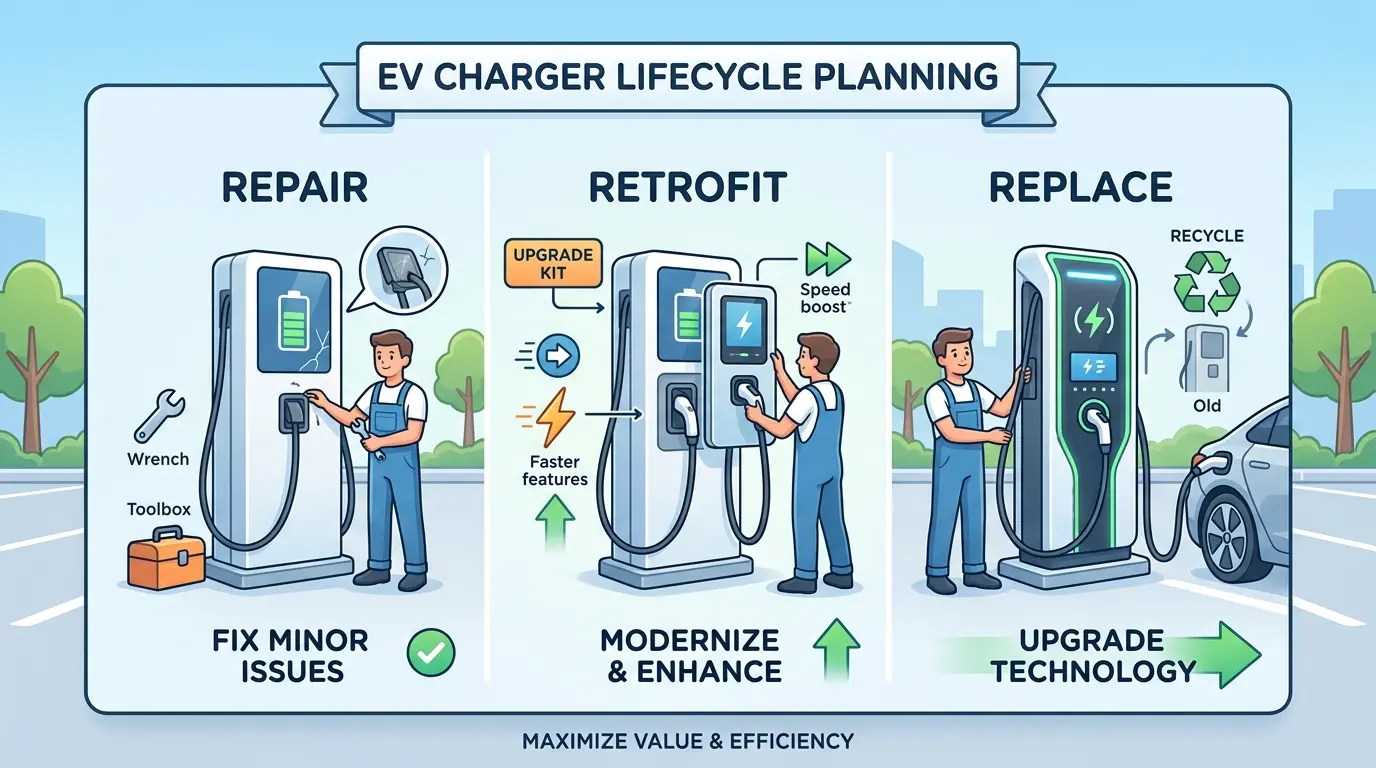
A charger rarely reaches the end of its useful life just because the installation date says so. It reaches that point when recurring faults start disrupting sessions, the site outgrows the original charging strategy, or outdated controls make operations harder than they need to be.
That is why lifecycle planning matters. For site hosts, fleet operators, charging-network planners, and infrastructure buyers, the real question is not simply how long a charger should last. It is whether the current asset still supports the site’s throughput, uptime expectations, software environment, and expansion plan. In many cases, the lowest-cost decision is to repair. In others, a targeted retrofit preserves value. And sometimes replacement is the only sensible move because the charger no longer fits the business.
Asset Age Does Not Tell the Whole Story
Chronological age is only one input in a lifecycle decision. A lightly used AC charger in a predictable workplace parking environment may continue to perform well long after a heavily used public charger at a high-turnover site starts showing operational strain. Duty cycle, exposure to heat or moisture, software support, spare-part availability, and charging demand all matter more than a simple year-in-service count.
The planning mistake is to treat all failures as proof that the hardware should be replaced or, on the other extreme, to keep repairing a unit that no longer matches the site’s real operating need. A charger can still be electrically serviceable while being commercially outdated. That usually happens when the site now needs stronger visibility, more dependable uptime workflows, or faster charging throughput than the original installation was designed to provide.
A practical starting point is to separate three questions:
- Is the current issue isolated or recurring?
- Does the charger still match the site’s charging pattern?
- Can the asset still operate inside the software, interoperability, and support model the business needs?
Once those answers are clear, the repair-versus-retrofit-versus-replace decision becomes much more disciplined.
Repair Makes Sense When the Charger Still Fits the Job
Repair is usually the right path when the charger still matches the site’s use case and the failure is localized rather than structural. A site with steady utilization, supported spare parts, and a charger class that still fits the power requirement can often recover value quickly through focused service work.
This is especially true when the fault is tied to wear items, connectors, cable damage, cooling components, contactors, display modules, or other serviceable assemblies rather than a broader mismatch between the asset and the site. In these cases, disciplined service backed by a clear preventive maintenance plan for EV charging stations often protects uptime better than rushing into capital replacement.
Repair tends to be the best choice when:
- Failure history is limited and not escalating
- Spare parts remain available within acceptable lead times
- The charger still meets required charging speed for the site
- Communication and monitoring functions remain usable
- The site is not facing a near-term change in traffic, fleet duty cycle, or business model
The risk is overusing repair as a holding pattern. If fault tickets are becoming routine, technician visits are increasing, or downtime is starting to damage driver confidence and site revenue, repair can shift from cost control to delay. At that point, the service invoice is no longer the only cost worth measuring.
Retrofit Makes Sense When the Site Has Changed Faster Than the Hardware
Retrofit sits between service and full replacement. It is the right path when the core charger platform is still physically and electrically useful, but the site now needs better controls, better connectivity, better user workflows, or tighter energy management than the original design provides.
Typical retrofit scenarios include adding stronger monitoring and remote-management capability, improving authentication or payment workflows, upgrading communication modules, renewing cable and connector assemblies, refreshing metering or user-interface layers, or integrating the charger into a smarter energy-management environment. In some cases, the most valuable retrofit is software-led rather than hardware-led, especially when a supported firmware update strategy can reduce faults, improve compatibility, or simplify maintenance without changing the entire charger body.
Retrofit is most attractive when:
- The enclosure, power stage, and site placement still make sense
- Civil works and utility connection are still usable
- Operators need more visibility, interoperability, or user control
- The charger remains well suited to the site’s power class
- A targeted upgrade can extend useful life without creating support complexity
The tradeoff is that retrofit only makes sense when it is building on a stable base. If buyers start spending heavily to modernize units with repeated reliability issues, unsupported components, or the wrong charging speed for present-day demand, retrofit can become an expensive way of preserving the wrong asset.
Replacement Is Usually the Right Call When the Problem Is Structural
Replacement becomes the rational choice when the charger no longer fits the business in a durable way. That can happen because failure patterns are worsening, critical parts are hard to source, the communication stack is no longer viable, or the site’s charging demand has moved beyond the original power class.
A common example is a site that was designed for low-pressure dwell-time charging but now needs higher throughput, stronger uptime discipline, or a broader operating model. In that scenario, the question is no longer whether the existing unit can be repaired one more time. The question is whether keeping it in service blocks the next stage of site performance. That is especially important for operators expanding public or commercial networks, where replacement decisions should be tied to the broader site-growth logic covered in what businesses should know before expanding EV charging infrastructure.
Replacement is usually the better path when:
- Downtime is recurring enough to affect site reputation or utilization
- Major assemblies are obsolete or vendor support is weak
- The charger cannot support the monitoring, access, or interoperability model now required
- Safety, compliance, or environmental resilience expectations have moved beyond the current unit
- The site now needs a different charging mix, such as moving from basic AC replenishment toward a blend of AC and DC capability
Replacement can also be the smarter choice when a business wants to standardize across locations. A broader EV charger portfolio matters here because lifecycle planning is often not about a single failed unit. It is about choosing the right mix of charger classes, site configurations, and future procurement options across an expanding network.
Compare the Three Paths by Total Business Impact
A lifecycle decision should not be based only on the next invoice. It should be based on the total operational effect of each option.
| Path | Best Fit | Main Advantage | Main Risk |
|---|---|---|---|
| Repair | Isolated faults on otherwise suitable, supported chargers | Lowest disruption and fastest return to service | Repeated service events can hide structural decline |
| Retrofit | Sound core hardware with outdated controls, connectivity, or user workflow | Extends asset value without full replacement scope | Money can be trapped in an aging platform if the base asset is weak |
| Replace | Structural reliability issues, support gaps, or clear site mismatch | Resets the site around current operational need and growth | Higher capital cost and longer project planning lead time |
Buyers should evaluate each option against the same business metrics:
- Expected downtime over the next 12 to 36 months
- Service call frequency and spare-part dependence
- User friction, failed sessions, and support burden
- Ability to scale with site demand
- Compatibility with the operator’s software and network model
- Utility, civil, and installation complexity if replacement is chosen
That is why budgeting discipline matters. Articles about EV charging station maintenance costs are useful not because they produce one universal number, but because they force buyers to compare recurring service exposure against the value of a cleaner long-term asset decision.
Do Not Ignore the Platform Layer
Many lifecycle decisions are misdiagnosed because the visible issue appears to be hardware while the operational bottleneck is actually in the software or network layer. A charger can be electrically healthy and still underperform if monitoring is poor, fault escalation is slow, remote reset options are weak, or the network platform no longer supports the operator’s workflow.
That is why retrofit and replacement planning should always include platform review. If the operator is changing software providers, access control, payment logic, or roaming architecture, the handover process matters almost as much as the physical charger. Otherwise a hardware refresh can still produce avoidable disruption. That is where EV charger network migration best practices become relevant, especially for sites that want to modernize without creating a second wave of downtime during transition.
In practice, the most durable lifecycle decisions treat charger hardware, firmware, network operations, and service workflows as one asset system. Repairing only the visible fault while leaving the management layer weak rarely solves the business problem for long.
Build a Portfolio Plan Instead of Reacting Unit by Unit
The strongest lifecycle programs do not treat every charger as an isolated decision. They classify assets into groups and manage them accordingly. One set may be kept in a repair-first service tier. Another may be scheduled for retrofit where the hardware base is still useful. A third may be earmarked for phased replacement because the site is changing, the charger class is wrong, or the support outlook is weakening.
A simple portfolio structure often works well:
- Stabilize: repairable assets that still fit the site and only need disciplined maintenance
- Extend: chargers worth retrofitting because controls, visibility, or user workflows need improvement
- Redesign: chargers or sites where replacement is tied to new throughput, new charger mix, or new network strategy
This approach also helps buyers align lifecycle spending with expansion timing. Instead of replacing assets opportunistically after failures, operators can coordinate service, retrofit, and replacement decisions with utility upgrades, parking-lot works, branding changes, or site redevelopment schedules.
For distributors, project developers, and OEM or ODM partners, this portfolio mindset is especially valuable because it links technical decisions to procurement planning. The result is usually better site fit, lower service disruption, and a clearer path for scaling infrastructure without overreacting to every individual fault event.
Practical Summary
Repair is the right choice when the charger still fits the site’s job and the problem is contained. Retrofit makes sense when the hardware base still has value but the site now needs better controls, connectivity, monitoring, or user workflow. Replacement is usually the right move when the issue is structural: recurring downtime, weak supportability, software incompatibility, safety exposure, or a charger class that no longer matches how the site operates.
The most important point is that lifecycle planning is not really about age. It is about fit. When buyers evaluate charger assets against operational need, support outlook, platform compatibility, and expansion plans, the decision becomes clearer and the capital is usually spent more effectively.
The sites that manage charger lifecycle best are not the ones that always repair or always replace. They are the ones that understand which assets still deserve maintenance, which can be modernized intelligently, and which should be retired before they start slowing down the business.