
 Deutsch
  Español
  Français
  Italiano
  Português
  Svenska
  Suomi
Suomi  Dansk
Dansk  Norsk bokmål
  Nederlands
  العربية
  עברית
עברית  Polski
  Türkçe
  Русский
  Uzbek
Uzbek  Azərbaycan
  Tiếng Việt
  ไทย
ไทย  한국어
한국어  日本語
日本語  简体中文
简体中文 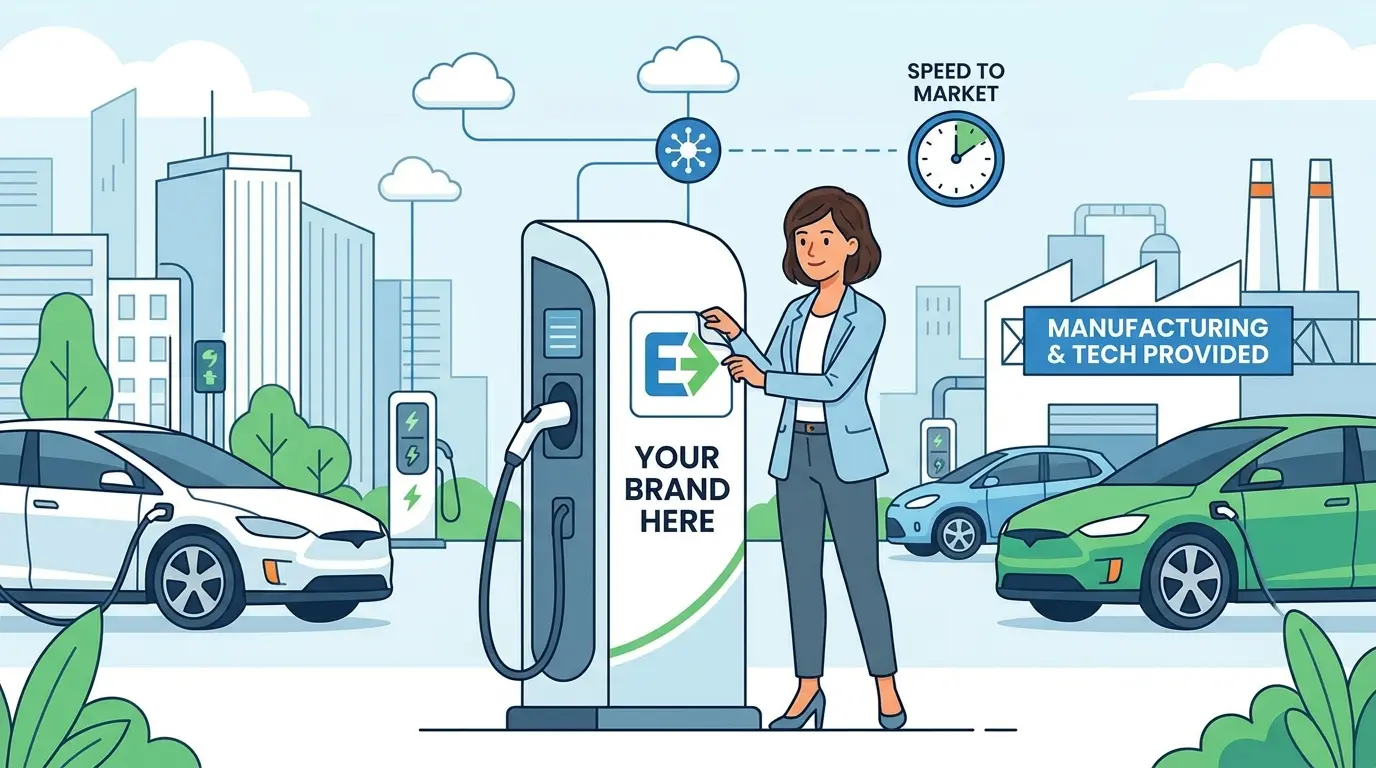
Launching an EV charger brand looks simple from a distance. Pick a housing, add a logo, publish a product page, and start talking to distributors or installers.
In practice, the real bottleneck is not branding. It is deciding which layers of the offer must be yours and which layers should come from an experienced manufacturing and software partner. Hardware, compliance, firmware, backend visibility, spare parts, field support, and regional adaptation all have to work together before the first serious buyer will trust the brand.
That is why many new entrants do better with a white-label or OEM and ODM model than with a ground-up build. The smarter route is not outsourcing everything. It is owning the commercial edge while using proven infrastructure for the parts that are hardest to build quickly and safely.
Start With a Market Wedge, Not a Full Catalog
A new charger brand usually fails when it launches too broadly. Trying to sell home chargers, workplace AC, public DC, fleet depots, and software management under one new label creates operational noise before the brand has real field data.
A more durable launch starts with one clear market wedge:
- workplace and commercial parking that need dependable AC charging
- distributors serving residential or light commercial installers
- fleet depots that need predictable overnight charging
- site hosts or CPOs targeting faster public or semi-public charging
That decision shapes almost everything else: power class, connector strategy, enclosure format, software expectations, certification priorities, and after-sales support.
If the first buyers are long-dwell users, an AC-first offer is often easier to price, install, and support. If the first buyers care about turnaround speed and charger throughput, the first conversation may need to center on faster DC deployment instead.
Decide What the Brand Must Own and What Can Stay Partner-Led
A white-label strategy works best when the brand owns the commercial and customer-facing pieces that matter most, while the partner handles the layers that are expensive to rebuild from scratch.
| Business Layer | Brand Should Usually Own Early | Better to Leverage From a Partner at Launch | Why This Split Works |
|---|---|---|---|
| Market positioning and channel strategy | Yes | No | This is where the brand creates differentiation |
| Visual identity, packaging, and documentation style | Yes | No | Buyers remember clarity and consistency |
| Core charger platform and power electronics | No | Yes | Rebuilding validated hardware slows launch and increases risk |
| Firmware maintenance and hardware testing | No | Yes | These are high-consequence functions with long validation cycles |
| Smart charging backend and device monitoring | Sometimes | Usually | Use a proven stack unless software is the main reason buyers choose you |
| Regional compliance documentation | Sometimes | Usually | Experienced manufacturers already know the approval workflow |
| Installer network, commissioning workflow, and first-line support | Yes | With partner backup | Local response is part of the brand promise |
| Warranty reserve, spare-parts planning, and escalation rules | Yes | With partner input | Support quality affects trust more than brochure claims |
This is the central discipline: own the parts that buyers will judge as your brand, and borrow the parts that buyers assume must already work.
Choose the Right White-Label Model for Your Stage
Not every white-label launch should start with the same degree of customization.
- Pure white-label is the fastest route.
A proven charger platform is sold under your branding with limited cosmetic or packaging changes. This is usually the best starting point when speed-to-market matters more than deep hardware differentiation. - Semi-custom ODM is often the most balanced route.
The manufacturer already has a working platform, but the product can be adapted for your region, power mix, enclosure details, communication features, or branding requirements. This usually makes the most sense when you need a credible local-market fit without funding a fully custom product. - Full custom development should usually wait.
A custom hardware program can make sense later, after the brand has channel traction, usage data, and clearer volume forecasts. Launching there too early can trap a new entrant in tooling costs, longer validation cycles, and a heavier support burden.
For many B2B entrants, the real opportunity is not inventing a new charger architecture. It is packaging a proven platform into a better commercial offer for a defined customer segment.
Pick the Right Hardware Class for the First Launch
Your first product line should reflect customer behavior, not ambition. A narrow, relevant offer is easier to sell than a broad catalog that no one fully understands.
| Launch Path | Best Fit | Why It Works for a New Brand | Main Watchout |
|---|---|---|---|
| AC smart charging | Workplaces, multifamily, light commercial parking, installer channels | Lower site complexity, steadier daily charging demand, easier rollouts | It is the wrong lead offer for customers who need high throughput |
| DC fast charging | Fleets, highway-adjacent sites, commercial destinations with shorter dwell | Stronger business case where turnaround time matters | Utility coordination, capital cost, and support expectations are higher |
| Mixed AC and DC portfolio | Brands with a clear channel strategy and operational maturity | Helps cover more scenarios once the first segment is proven | Launching both too early can dilute execution |
If the target market is AC-led, it is usually smarter to start with a focused AC charging portfolio than to promise every power class at once. If the target market is built around commercial turnover or fleet readiness, a DC charging range may be the more credible starting point.
Once channel demand becomes clearer, a broader EV charger portfolio can help the brand expand without changing manufacturing partners or fragmenting procurement.
Do Not Rebuild the Software Stack Unless It Wins Deals
Many new charger brands underestimate how much value buyers place on the control layer. They may tolerate modest differences in enclosure design, but they care deeply about visibility, uptime, user access, remote diagnostics, and future interoperability.
That is why building a custom backend from day one is often a distraction. Unless the software itself is your commercial wedge, it is usually better to launch on a proven platform that already supports monitoring, load management, reporting, and remote control.
Interoperability is especially important for enterprise buyers. If the brand cannot clearly explain open-protocol readiness, it may struggle in serious tenders. PandaExo’s guide to what OCPP means for commercial EV stations reflects the same reality: buyers do not want a charger that works only inside a closed operating model.
The same logic applies to uptime. A white-label brand will still be blamed for weak alerting, poor remote support, and slow firmware governance, even if those issues originated deeper in the supply chain. That is why the service model behind the platform matters as much as the app interface.
Treat Compliance and Localization as Product Work
A charger can look market-ready and still be commercially unusable if the certification, connector format, labeling, language, metering logic, or documentation does not match the target region.
For a white-label brand, this is where partner quality shows up quickly. A manufacturer that understands regional adaptation can shorten the gap between pilot and commercial rollout. One that does not will push hidden work back to the brand team.
Before launch, clarify:
- target market standards and connector requirements
- certification pathway and document ownership
- language and labeling requirements
- billing or payment expectations by market
- installer documentation, wiring guides, and commissioning workflows
- replacement and spare-parts policy by region
For buyers, certification is not an administrative detail. It is part of procurement risk. PandaExo’s CE and TUV certification guide for EV chargers is a good reminder that approval discipline directly affects trust, rollout timelines, and channel confidence.
Build the Support Model Before the First Shipment
A new EV charger brand is not judged only by how the charger looks on launch day. It is judged by what happens after installation.
Can installers commission the units quickly? Are spare parts easy to source? Who handles firmware updates, device alarms, or connector failures? How fast can the brand respond if a site goes partially offline?
This is where many white-label strategies break down. The brand assumes support can be figured out later, but the first commercial buyers want those answers upfront. PandaExo’s article on EV charging network uptime strategy is relevant here because network reliability depends on operational process, not just hardware quality.
The good news is that first-line support does not have to be fully in-house on day one. A practical launch model often combines:
- local brand ownership of customer communication
- partner-backed technical escalation
- predefined spare-parts logic
- remote monitoring and firmware governance from a proven platform
- clear installer and commissioning documentation
That structure lets the brand stay customer-facing without pretending it already has a mature global service organization.
Use OEM and ODM Capability as a Growth Tool, Not Just a Sourcing Tool
The real value of OEM and ODM support is not that it helps you buy chargers anonymously. The real value is that it gives the brand room to evolve.
Once the first segment is working, OEM and ODM flexibility can support:
- localized branding for distributor channels
- connector or configuration changes for different geographies
- enclosure or interface adjustments for specific site types
- bundled software and reporting options for enterprise accounts
- staged expansion from AC-only into mixed AC/DC offerings
This is where a partner with factory-direct scale, power-conversion credibility, and a multi-scenario charging portfolio becomes more useful than a simple contract manufacturer. PandaExo’s positioning is relevant precisely because the brand is built around smart charging hardware, platform visibility, and OEM/ODM flexibility rather than a single product class.
A Practical Launch Sequence for the First 6 to 12 Months
A realistic white-label EV charger launch usually looks like this:
- Define one buyer segment and one launch geography.
Choose the first customer type before choosing the first SKU. - Select a manufacturing partner with proven hardware and software depth.
Look for AC and DC portfolio coverage, regional adaptation ability, documentation maturity, and OEM and ODM flexibility. - Freeze the first launch configuration.
Do not let the first commercial phase expand into too many power classes, payment models, or custom features. - Pilot under real operating conditions.
Use live installer feedback, real commissioning friction, and support cases to refine the offer. - Build the support and warranty workflow around actual field issues.
This is where brand credibility becomes durable. - Expand only after the first segment is stable.
Add adjacent SKUs, markets, or customization layers once the initial channel model is working.
This sequence is slower than a logo-first launch on paper, but faster in real commercialization because it reduces rework.
Practical Summary
Launching a white-label EV charger brand does not require building every layer in-house. It requires being deliberate about which layers deserve internal ownership and which layers should come from a capable manufacturing and platform partner.
In most cases, the brand should own the market positioning, channel strategy, customer experience, installer relationships, and support promise. The partner should shoulder more of the validated hardware platform, firmware maintenance, compliance groundwork, and backend operating foundation.
That is the practical advantage of working with a supplier that can support AC and DC charging, smart management visibility, and OEM and ODM adaptation under one framework. The brand gets to move faster without pretending it has to invent the full stack from zero.
The companies that launch well are not the ones that outsource blindly. They are the ones that know exactly what must be their brand, what can remain partner-led, and how to turn that split into a commercially credible offer.