
 Deutsch
  Español
  Français
  Italiano
  Português
  Svenska
  Suomi
Suomi  Dansk
Dansk  Norsk bokmål
  Nederlands
  العربية
  עברית
עברית  Polski
  Türkçe
  Русский
  Uzbek
Uzbek  Azərbaycan
  Tiếng Việt
  ไทย
ไทย  한국어
한국어  日本語
日本語  简体中文
简体中文 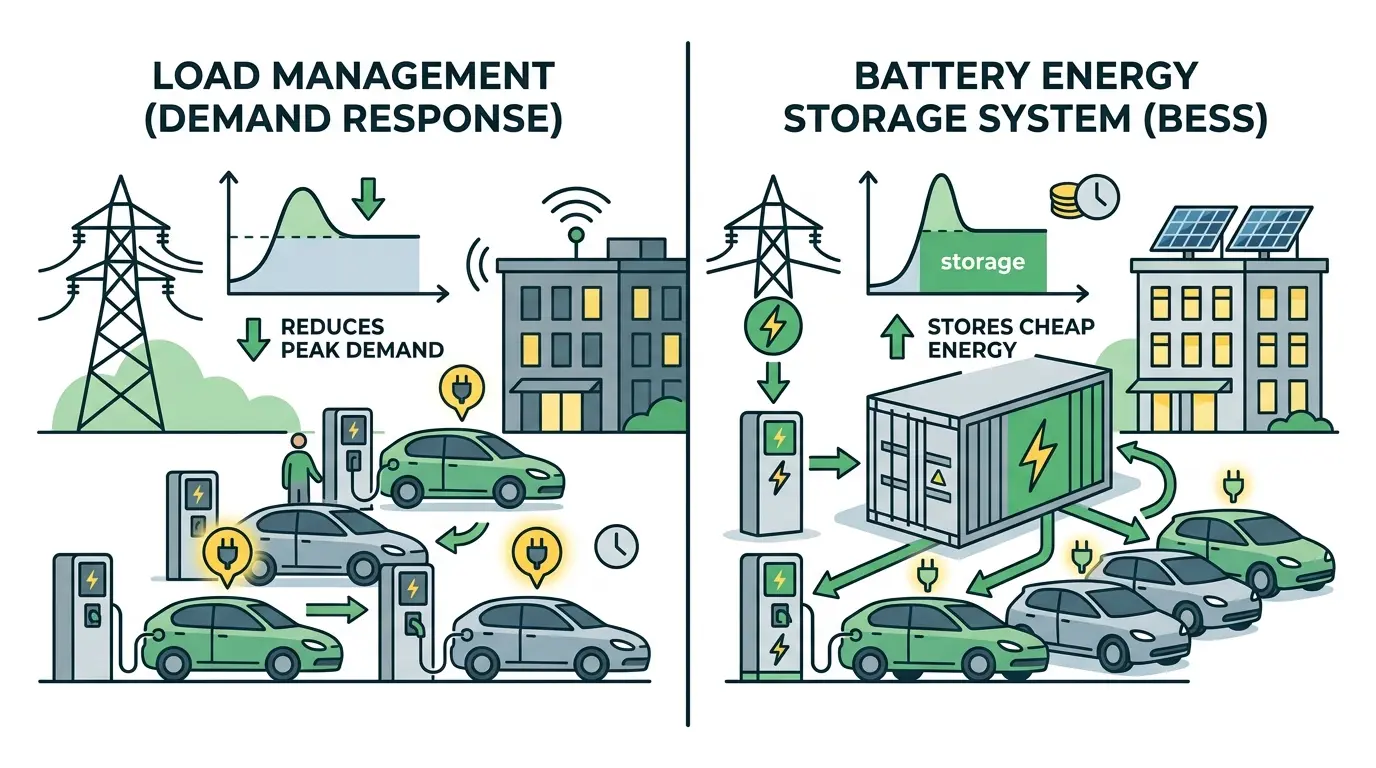
A charging site does not become expensive only because electricity costs money. It becomes expensive when too many vehicles demand power at the same moment, the utility meter records a short but severe spike, and the project team is forced to choose between oversizing the grid connection or constraining charging performance. That is why peak demand has become one of the most important planning issues in commercial EV infrastructure.
For most buyers, the real question is not whether load management or battery storage is the more advanced solution. The real question is which one reduces peak-related cost without damaging throughput, site fit, or future expansion plans. In many cases, the answer is load management first and storage later. In some cases, storage earns its place immediately. The difference comes down to charging behavior, business model, and grid constraints.
Why Peak Demand Becomes Expensive So Quickly
Peak demand costs usually show up in three places: demand charges on the utility bill, utility-side upgrade requirements, and underused capital tied up in electrical capacity that is rarely needed outside short operating windows. A site may look reasonable on an average daily energy basis but still become financially difficult because several chargers ramp at once.
That problem gets sharper as operators add faster chargers, longer operating hours, or more vehicles per site. Buyers planning around transformer limits, interconnection lead times, and demand-charge exposure should treat peak demand as a front-end design issue rather than a late-stage correction. PandaExo’s audience often faces this during multi-charger expansion, especially when fleets or public sites begin moving beyond basic installations into higher-power, business-critical infrastructure. For a deeper planning view, PandaExo’s guide to utilities and EV charging outlines how grid capacity and tariff structure shape project economics.
What Load Management Actually Solves
Load management reduces peak demand by controlling how much power chargers can draw at the same time. Instead of allowing every charger to operate at full rated output whenever a vehicle plugs in, the system allocates available power across chargers according to rules such as arrival time, fleet schedule, state-of-charge targets, or site-level limits.
In practice, that can mean capping total site demand, shifting non-urgent sessions into off-peak windows, or dynamically sharing available capacity across multiple chargers. The value is straightforward: operators can serve more charging points without matching each connector with equivalent grid headroom. That makes load management especially attractive where vehicles dwell long enough to tolerate variable charging power.
This is why dynamic controls are often the first answer for apartment, workplace, depot, and commercial parking deployments. In those environments, the goal is usually not maximum instantaneous power at every connector. It is dependable charging across many vehicles within a known time window. PandaExo’s article on dynamic load management shows how this approach helps sites expand without triggering unnecessary infrastructure upgrades.
What Battery Energy Storage Actually Solves
Battery energy storage addresses the same peak problem from a different direction. Instead of only controlling the chargers, it adds a local energy buffer that can discharge during short peak events and recharge when site demand is lower. That can reduce the power pulled from the grid during expensive intervals, support fast charging on weaker grid connections, and in some cases improve resilience during outages or unstable supply conditions.
The advantage is that storage can protect charging speed where throttling would hurt the business case. If a highway corridor, turnaround-sensitive fleet yard, or premium public charging site depends on fast sessions to keep utilization high, a battery can absorb some of the peak burden without forcing the charger to slow down at the worst moment.
But storage is not just a peak-shaving accessory. It brings its own capital cost, control complexity, thermal and safety requirements, lifecycle considerations, and integration work with the site energy management system. Buyers should evaluate it as an infrastructure asset, not as a simple add-on.
The Cost Logic Is Different
Load management and storage can both reduce peak-related cost, but they do so through very different economic mechanisms.
| Decision Factor | Load Management | Battery Energy Storage | Commercial Impact |
|---|---|---|---|
| Upfront capital requirement | Usually lower | Usually higher | Load management is often easier to approve early in a rollout |
| Deployment speed | Often faster if chargers and controls are already planned | Slower due to additional equipment and engineering scope | Storage can extend project timelines |
| Demand-charge reduction | Strong when charging sessions are flexible | Strong when peaks are sharp and unavoidable | Tariff structure matters more than theory |
| Charger throughput protection | Can reduce throughput if power is shared too aggressively | Better at preserving fast charging during peaks | Public fast charging often values speed more highly |
| Grid-upgrade deferral | Effective when site demand can be shaped | Effective when weak-grid conditions are severe | Storage becomes more attractive when utility upgrades are slow or costly |
| Operational complexity | Lower | Higher | Battery controls, maintenance, and lifecycle management must be budgeted |
| Resilience value | Limited on its own | Can support backup-oriented site strategies | Storage may solve more than one problem if resiliency matters |
The key point is that load management saves money by making demand more orderly. Storage saves money by supplying part of the demand locally during the most expensive moments. One is mainly a control strategy. The other is mainly a power asset. They should not be evaluated with the same assumptions.
When Load Management Usually Wins
Load management tends to be the more cost-effective answer when charging demand is flexible, predictable, or spread across longer parking durations.
- Fleet vehicles return on known schedules and can be charged over several hours rather than all at once.
- Multifamily, workplace, and destination sites want more connectors without funding a large service upgrade.
- The business model values charging availability more than maximum charging speed per session.
- The site is in an early expansion phase and utilization data is still limited.
- The operator wants the lowest-risk way to scale before committing capital to more complex energy assets.
This is especially true for sites built around managed AC charging, where session dwell times naturally give the control system room to optimize power distribution. Buyers comparing slower but more numerous charging points can review PandaExo’s broader AC charging portfolio as part of a phased, capacity-aware deployment strategy.
When Battery Storage Can Justify The Spend
Battery storage becomes easier to justify when throttling power would directly weaken revenue, service quality, or fleet productivity.
- High-power public charging depends on fast turnaround and visible charger performance.
- Depot operations have narrow dispatch windows and cannot extend charging duration without affecting vehicle readiness.
- Utility upgrades are delayed, expensive, or operationally uncertain.
- Demand charges are disproportionately high relative to total energy cost.
- The site also values resilience, backup capability, or future participation in broader energy-management strategies.
For buyers operating higher-power sites, especially those centered on DC charging infrastructure, storage can be less about theoretical efficiency and more about preserving service levels when the grid connection lags behind market demand.
Why The Lowest-Cost Answer Is Often A Hybrid
In real deployments, the choice is often not binary. Many successful projects use load management to flatten routine demand and a smaller battery system to handle the hardest peaks that remain. That hybrid approach can reduce battery size, preserve more charging speed, and avoid paying for storage capacity that would sit idle most of the time.
This matters because not every peak is equally expensive. Some sites experience manageable daily variation plus a few high-stress windows. In those cases, using controls as the first layer and storage as the second layer can produce a better cost-to-performance outcome than relying entirely on one method.
That is also a procurement advantage. Instead of overcommitting at day one, operators can start with smart charger controls, gather utilization data, and then decide whether battery capacity is truly required. PandaExo’s commercial EV charging project checklist is useful here because the economics are shaped as much by phasing and site assumptions as by hardware selection.
How Buyers Should Decide
A practical buyer framework starts with four questions.
| Question | If The Answer Is Mostly Yes | Likely Best Starting Point |
|---|---|---|
| Can vehicles stay plugged in long enough to tolerate managed charging? | The site has flexibility | Load management |
| Does slower charging during peak windows damage revenue or operations? | Speed is business-critical | Storage or hybrid |
| Are utility upgrades expensive, delayed, or uncertain? | Grid constraints are serious | Storage or hybrid |
| Is the site still early enough to learn from real usage before locking in capital? | Demand is still emerging | Load management first |
The mistake is assuming the highest-power or most technologically complex option is automatically the most future-ready. In many projects, the most future-ready choice is the one that preserves optionality. Control the load first, learn the usage pattern, then add storage only where the business case stays strong after real operating data is available.
Where PandaExo Fits In The Decision
For PandaExo buyers, this topic is not only about one piece of equipment. It is about aligning charger type, site control strategy, and expansion pathway. A portfolio that includes AC and DC charging hardware, together with smart energy management logic, gives operators room to solve peak demand in stages instead of forcing a single all-or-nothing infrastructure decision.
That staged approach is often the most commercially disciplined one. It helps site hosts, network planners, and OEM or ODM partners match investment to actual operating pressure rather than to worst-case assumptions.
Practical Summary
Load management is usually the more cost-effective first move because it addresses peak demand with lower capital intensity and faster deployment. It works best when charging behavior is flexible enough to shift or share power without harming operations.
Battery energy storage becomes more compelling when the site cannot afford to slow charging, when grid constraints are severe, or when resilience and power buffering add extra business value beyond peak shaving alone.
For many commercial EV projects, the smartest answer is not load management versus storage in absolute terms. It is load management first, storage where the data proves it, and a hybrid model when the site must balance throughput, demand-charge control, and expansion readiness at the same time.