
 Deutsch
  Español
  Français
  Italiano
  Português
  Svenska
  Suomi
Suomi  Dansk
Dansk  Norsk bokmål
  Nederlands
  العربية
  עברית
עברית  Polski
  Türkçe
  Русский
  Uzbek
Uzbek  Azərbaycan
  Tiếng Việt
  ไทย
ไทย  한국어
한국어  日本語
日本語  简体中文
简体中文 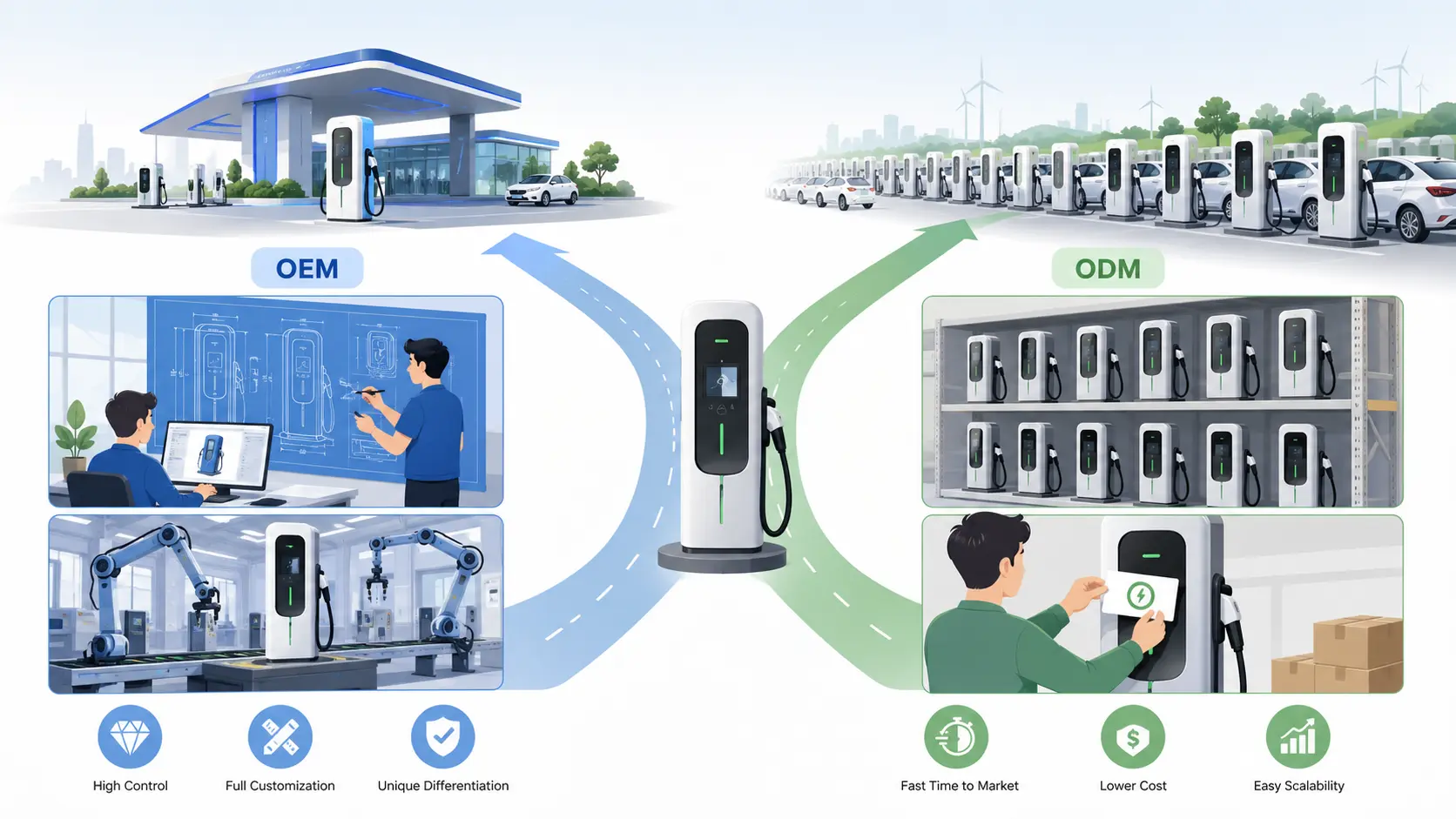
Many EV charging companies assume the branding decision comes late. In practice, it shows up much earlier. A distributor entering a new region, a fleet-focused solutions provider, or a charging-network planner building a private-label offer often has to decide whether to launch on an existing charger platform or invest in a product strategy with more control.
That is the real OEM versus ODM question. It is not only about whose logo goes on the enclosure. It affects speed to market, product differentiation, certification planning, firmware ownership, after-sales workflows, and how much operational complexity your team is willing to absorb.
For most B2B buyers, neither model is universally better. The right answer depends on whether your market strategy is driven by rapid entry, brand control, channel differentiation, specialized technical requirements, or long-term portfolio ownership.
Why This Decision Matters Earlier Than Many Teams Expect
In the EV charger market, partnership structure influences more than product appearance. It shapes how quickly you can launch, how much customization is realistic, and how much internal capability you need to support the business after the first shipment.
If your strategy is to test demand quickly, enter multiple channels, or offer a reliable charger line without building a product-management function from scratch, an ODM path is often more commercially practical. If your strategy depends on owning a more distinctive hardware and software proposition, controlling configuration deeply, or tailoring products for a specialized market segment, OEM may be the better fit.
This is why the partnership model should be evaluated alongside channel design, service capability, and platform governance. It belongs in the same planning conversation as interoperability, software responsibilities, and launch readiness, not as a last-minute procurement choice.
What OEM Usually Means in EV Charging
In EV charging, OEM is often used loosely, so buyers should define it carefully in writing. In most B2B contexts, OEM means the manufacturing partner builds a charger program around the buyer’s commercial and technical requirements rather than simply supplying an existing catalog product with minor cosmetic changes.
That usually gives the buyer more influence over areas such as:
- product appearance and branding language
- selected hardware configuration or enclosure format
- connector and regional market alignment
- firmware behavior or user-interface requirements
- packaging, documentation, and channel presentation
- long-term roadmap fit for the buyer’s own market position
The benefit is stronger differentiation. The tradeoff is heavier responsibility. OEM programs usually require clearer specifications, stronger change control, more structured validation, and a better-defined support model. They can make sense when the charger line is meant to be part of your brand identity rather than just a vehicle for near-term sales.
What ODM Usually Means in EV Charging
ODM generally means the manufacturer already has a developed charger platform, and the buyer adapts that platform for market use with a more limited customization scope. That may include branding, packaging, some interface changes, market-specific configuration, and selected feature adjustments, but the underlying product architecture is typically owned by the manufacturer.
This model is often attractive because it reduces development burden. The platform already exists, which can make launch timing, validation effort, and operational planning more manageable. For distributors, market entrants, and channel partners that want to move quickly, ODM can be the fastest path to a credible commercial offer.
The tradeoff is that differentiation is narrower. If multiple companies are drawing from similar product platforms, your advantage has to come more from service model, channel execution, pricing discipline, software experience, or market focus than from a deeply unique charger design.
OEM vs. ODM: The Real Tradeoffs
| Decision Factor | OEM Is Often Stronger When | ODM Is Often Stronger When | What Buyers Should Watch |
|---|---|---|---|
| Speed to market | Launch timing is less important than long-term product control | Fast entry matters more than deep customization | Do not assume custom work will move at catalog speed |
| Differentiation | Your charger line is part of your brand strategy | Your commercial edge comes from channel execution or service | Branding alone does not create real product separation |
| Internal engineering demand | You can define requirements and manage validation discipline | You want a lighter internal product-management burden | Hidden complexity often appears after launch, not before |
| Software and firmware influence | You need stronger say over feature behavior or roadmap direction | Existing platform capabilities already fit the use case | Clarify who owns updates, issue prioritization, and support escalation |
| Regional adaptation | Your markets require specific combinations of connectors, standards, or UX expectations | You are entering markets already supported by a mature platform | Write the exact adaptation scope into the agreement |
| Procurement simplicity | You can manage a more structured specification and approval process | You need a faster, repeatable supply path | Change requests can affect lead time and commercial terms |
| Margin strategy | Your long-term model depends on a more proprietary offer | You need a lower-friction route to revenue generation | Margins depend on service model and positioning, not only factory model |
| After-sales operations | You are building a branded product ecosystem with dedicated support workflows | You want to lean more on an established platform base | Spare parts, firmware handling, and field support must be defined early |
Which Model Fits Common EV Charging Market Strategies?
The right partnership model becomes clearer when you look at the business model behind the charger program.
| Market Strategy | Better Starting Fit | Why |
|---|---|---|
| Enter a new market quickly with a private-label offer | ODM | Reduces time-to-launch pressure and limits product-development burden |
| Build a charger line around a strong existing distribution network | ODM | Lets the team focus on channel growth, pricing, and service execution |
| Create a more distinctive long-term branded portfolio | OEM | Supports deeper alignment between product identity and company strategy |
| Serve specialized fleet, depot, or infrastructure niches | OEM | More room to adapt hardware, workflow, or platform behavior to a defined use case |
| Test demand before committing to a broad product roadmap | ODM | Keeps risk lower while market feedback is still forming |
| Expand from standard products into more tailored solutions over time | Hybrid path | Allows the business to start quickly and customize more selectively later |
This is also where charger class matters. A partner entering the market with reliable workplace or commercial parking products may be well served by an ODM-led approach around AC charging solutions. A company targeting fleet depots, corridor infrastructure, or higher-throughput commercial sites may eventually need a more tailored strategy around DC charging systems if the commercial model depends on deeper technical alignment.
Questions to Ask Before You Choose
The biggest mistake in OEM and ODM discussions is assuming the labels answer the operational questions. They do not. Buyers should ask what the partnership actually looks like in execution.
Key questions include:
- What parts of the charger are truly configurable, and what parts are fixed?
- Who controls the firmware roadmap, bug handling, and release priority?
- What regional standards, connector options, and compliance pathways are already supported?
- How are change requests handled once the first production run is approved?
- What lead-time impact should be expected from custom enclosure, interface, or documentation changes?
- Who manages field issues, spare parts, and technical escalation after deployment?
- Can the same supplier framework support both current products and future portfolio expansion?
Those questions are especially important when software responsibility is unclear. PandaExo’s article on EV charger software vs. firmware is useful here because many channel conflicts begin when partners discover too late that branding control and firmware control are not the same thing.
Interoperability should also be reviewed early. If your market strategy includes platform migration flexibility, roaming readiness, or broader ecosystem compatibility, product selection cannot be separated from protocol support. PandaExo’s guide to open charging networks is relevant because a charger that fits the business visually but creates long-term platform lock-in may weaken your market position over time.
Why a Hybrid Path Often Makes More Sense Than a Pure Choice
For many EV charging businesses, the most practical answer is not purely OEM or purely ODM. It is staged evolution.
An organization may begin with ODM to accelerate market entry, validate demand, and build after-sales capability. Once channel performance is clearer, the same business may move selected product lines toward OEM customization where margin, brand identity, or specialized deployment needs justify the added complexity.
This staged approach is often more disciplined than trying to customize everything at the start. It lets the market reveal where differentiation really matters. In many cases, standard products are sufficient for part of the portfolio, while only certain segments need deeper customization.
Examples include:
- launching a standard AC line quickly, then tailoring higher-value commercial products later
- using established products for general distribution while customizing fleet-focused variants
- starting with private-label market entry, then developing a more distinct branded roadmap after channel traction is proven
That is also why buyers should evaluate supplier breadth, not only one charger SKU. A partner with a broader EV charger portfolio can make phased market development easier because the business does not have to rebuild its supplier logic every time it adds a new power class or deployment scenario.
Where PandaExo Fits in This Decision
PandaExo’s relevance is practical rather than abstract. Businesses weighing OEM and ODM options often need more than a factory. They need enough product breadth, charging-class coverage, and platform thinking to support a market strategy that may change over time.
That matters for distributors that want a faster market-entry path, for infrastructure buyers that need product fit across different site types, and for channel programs that may eventually require more branded or customized positioning. It also matters when the charger decision has to stay connected to network visibility, rollout planning, and service workflows rather than being treated as a one-time hardware purchase.
This is why early planning discipline still matters. Before choosing a partnership model, buyers should verify commercial readiness, site fit, software responsibilities, and support structure with the same rigor they apply to product selection. PandaExo’s commercial EV charging project checklist is a useful reminder that partnership fit and deployment fit should be evaluated together.
Practical Summary
OEM is usually the better fit when your charger program is meant to become a more differentiated part of your brand, your team can manage a more structured product process, and long-term control matters more than launch speed.
ODM is usually the better fit when market entry speed, lower complexity, and faster commercial execution matter more than deep architectural control.
In practice, the strongest decision usually follows five rules:
- choose ODM when speed and lower execution risk matter most
- choose OEM when product differentiation is central to market strategy
- define scope in writing because OEM and ODM labels are not precise enough on their own
- test software, firmware, and interoperability responsibilities before signing
- leave room for a staged model if the business may evolve from fast entry to deeper customization
The best partnership model is the one that supports how you plan to sell, deploy, support, and expand EV charging in the real market. Not every business needs maximum customization. Not every business should stay close to an off-the-shelf platform forever. The right answer is the one that matches your commercial ambition with the operational structure you can actually sustain.