
 Deutsch
  Español
  Français
  Italiano
  Português
  Svenska
  Suomi
Suomi  Dansk
Dansk  Norsk bokmål
  Nederlands
  العربية
  עברית
עברית  Polski
  Türkçe
  Русский
  Uzbek
Uzbek  Azərbaycan
  Tiếng Việt
  ไทย
ไทย  한국어
한국어  日本語
日本語  简体中文
简体中文 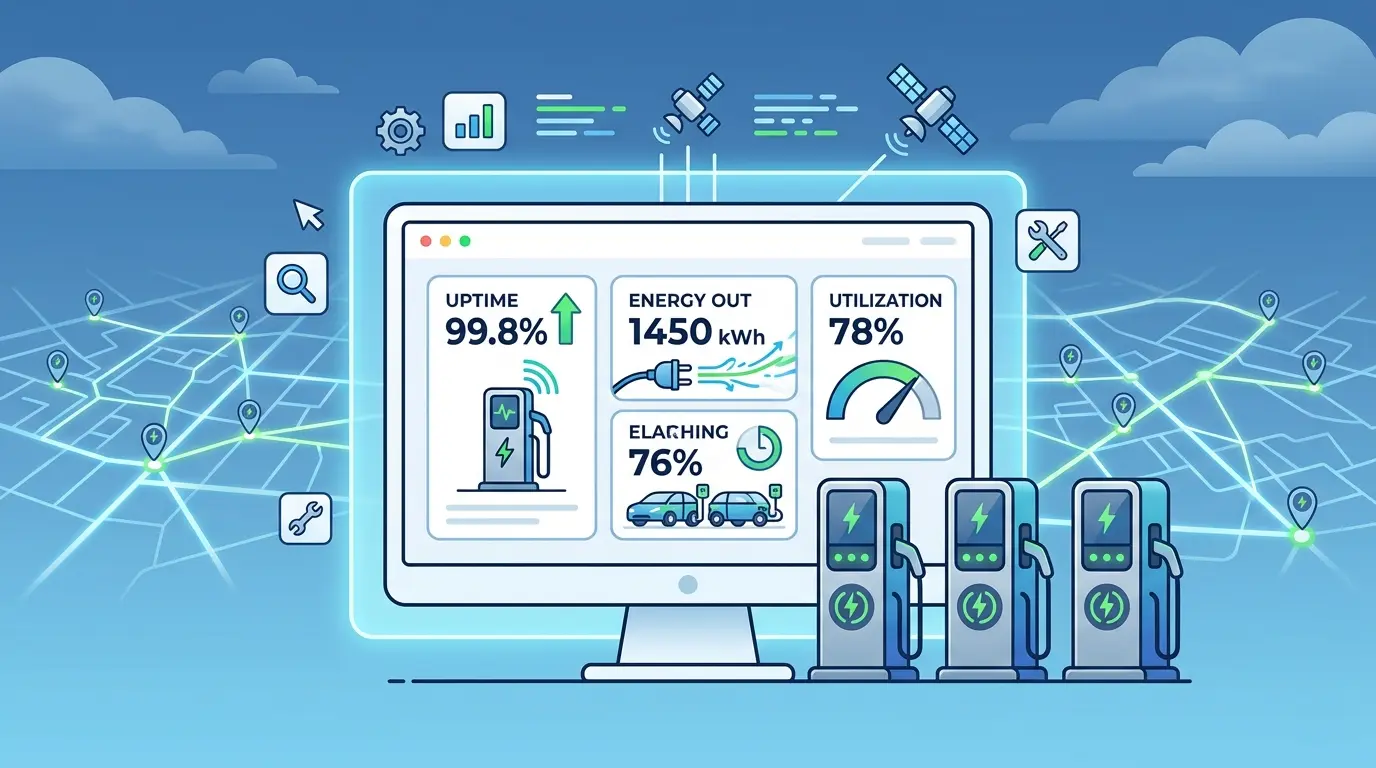
A charging network rarely loses trust because one charger throws one fault. Trust erodes when operators discover recurring issues too late, cannot tell which alarms actually threaten service, or rely on dashboard totals that look healthy while drivers still fail to start sessions.
That is why remote monitoring should be built around operational KPIs, not vanity metrics. For charging network operators, the goal is not simply to know that equipment is online. The goal is to know whether drivers can charge successfully, whether site capacity is being used well, whether faults are being cleared fast enough, and whether the network can scale without hidden service or revenue leakage.
Start With KPI Groups That Reflect How Networks Actually Fail
The most useful remote monitoring programs organize KPIs into a few practical control areas rather than one oversized dashboard.
| KPI Group | What It Answers | Why It Matters |
|---|---|---|
| Availability | Can drivers access a working connector right now? | Protects uptime, reputation, and contract performance |
| Session reliability | Are charging sessions starting and completing successfully? | Reveals user-facing friction faster than raw uptime |
| Utilization and throughput | Is installed capacity being used productively? | Helps operators judge site fit, expansion timing, and charger mix |
| Alarm response and recovery | How quickly is the team identifying and clearing faults? | Limits downtime duration and service escalation |
| Communications and control | Is the network actually visible and manageable remotely? | Prevents blind spots, stale data, and failed remote actions |
| Firmware, configuration, and revenue control | Is the network operating on the right software, tariffs, and rules? | Reduces drift, failed updates, and billing risk |
Operators who group KPIs this way can assign ownership more clearly across NOC teams, service partners, software teams, and commercial operations.
Track Service Availability, Not Just Charger Online Status
Many networks still overuse a simple online versus offline metric. That number matters, but it is not enough. A charger can appear online while still being unavailable because of payment issues, connector faults, emergency stops, thermal derating, or authorization failure.
The stronger KPI is service availability at the connector level. In practice, operators should monitor:
- Connector availability rate
- Unplanned downtime by site and by connector
- Planned maintenance downtime tracked separately
- Percentage of sites with at least one working connector versus full-site outage
- Availability by charger class, since AC and DC portfolios behave differently
This distinction becomes important in mixed estates. A network average may look acceptable while one high-value site repeatedly drops below usable capacity. PandaExo’s guide to EV charging network uptime strategy is useful here because it frames uptime as a workflow issue, not only a hardware condition.
Session Success Rate Tells You More Than Headline Uptime
If drivers can see a charger, authenticate, plug in, and still fail to start or complete a session, the network has a service quality problem even when uptime appears high. That makes session success one of the most important remote monitoring KPIs for any operator.
The core measurements usually include:
- Session start success rate
- Authorization success rate for app, RFID, and roaming users
- Failed session rate by failure reason
- Session completion rate
- User-aborted session rate after fault or delay
- Average time from plug-in to energy delivery
This KPI set is especially valuable because it shows where customer friction lives. A site may have acceptable physical availability but weak roaming performance, payment failures, or repeated timeout issues. Those are operational defects, not just software inconveniences.
Measure Utilization Alongside Throughput, Not in Isolation
Utilization is often the first KPI executives ask about, but it becomes misleading when it is detached from energy throughput and dwell behavior. A heavily occupied charger is not automatically a productive one, and a lightly occupied charger is not always underperforming.
Operators should usually monitor utilization with at least four companion metrics:
- Sessions per connector per day
- kWh delivered per connector per day
- Average charging time versus total occupied time
- Peak-hour utilization versus off-peak utilization
These measurements help answer better questions. Is the charger genuinely moving energy, or is it blocked by long parking dwell? Is the site designed for fast turnover, or is it functioning more like destination charging? Is the operator facing a demand problem, a parking-policy problem, or a power-delivery problem?
The same logic matters for portfolio benchmarking. AC workplace chargers, overnight depot charging, and public DC fast charging hubs should never be forced into the same utilization target. Remote monitoring is only useful when thresholds reflect the site’s real operating pattern.
Alarm Response KPIs Show Whether Remote Support Is Actually Working
Alarm volume alone is not a helpful KPI. Most operators do not need more alerts. They need to know whether alerts are being prioritized correctly and resolved before they damage service performance.
That is why alarm handling should be monitored with response and recovery metrics such as:
- Mean time to acknowledge critical alarms
- Mean time to diagnose remotely
- Mean time to remote recovery
- Mean time to dispatch on-site service when remote recovery fails
- Repeat fault rate within 7 or 30 days
- Truck roll rate per 100 active chargers
These metrics separate mature operations from reactive ones. If acknowledgement is fast but remote recovery is weak, the issue may be tooling, permissions, or incomplete telemetry. If repeat faults stay high, the operator may be clearing symptoms rather than root causes.
Communications Health Is a Leading Indicator, Not a Technical Footnote
Operators sometimes treat communications stability as a backend IT issue. In practice, it is one of the clearest leading indicators of future downtime, stale KPI reporting, and failed remote actions.
Useful communications KPIs include:
- Charger heartbeat loss rate
- Percentage of chargers with intermittent connectivity
- Telemetry freshness or last-report age
- Remote command success rate
- OCPP session message failure rate
- Percentage of chargers reporting complete metering and fault data
This is also where protocol choice and interoperability start to matter. PandaExo’s explainer on open charging networks is relevant because a network that cannot maintain clean charger-to-platform communication will struggle to scale KPI discipline, roaming quality, or third-party integration.
Firmware and Configuration Compliance Deserve Their Own KPI Set
Remote monitoring should not stop at observing faults. It should also confirm that the network is running on the intended software and configuration baseline. Otherwise, operators end up comparing performance across a portfolio that is no longer configured consistently.
The most practical compliance KPIs are:
- Percentage of chargers on the approved firmware version
- Firmware update backlog by priority tier
- Failed firmware update rate
- Configuration drift rate across tariffs, access rules, and charging limits
- Rollback incidents after software changes
- Percentage of devices missing required certificates or communication settings
This matters because many reliability issues are introduced during change, not during steady-state operation. PandaExo’s article on EV charger firmware update strategy is a useful reference point: firmware governance should be monitored as part of uptime protection, not treated as a separate engineering chore.
Power Delivery KPIs Reveal Whether Capacity Is Being Used Efficiently
A charger that is technically available but repeatedly delivering below expected power can still create user dissatisfaction and weak site economics. That is why remote monitoring should include power-performance KPIs, especially for commercial and fleet environments.
Operators should watch:
- Average delivered power versus expected power by charger class
- Derating frequency caused by thermal, grid, or equipment constraints
- Peak coincident load at the site level
- Load balancing intervention frequency
- Energy delivered per reserved capacity window
- Demand-charge exposure periods where applicable
These KPIs help operators see whether a site is merely active or genuinely productive. They also help reveal whether the problem sits in charger hardware, site electrical constraints, or network control settings.
Revenue Leakage and Commercial Control Should Be Monitored Remotely Too
Remote monitoring is often framed as a maintenance function, but it should also protect the commercial side of the network. An operator can lose margin through billing gaps, tariff mismatches, and incomplete session records long before finance notices the pattern.
Key commercial monitoring KPIs include:
- Completed but unbilled session rate
- Payment capture failure rate
- Tariff synchronization success rate across chargers and platform
- Free-vend or unintended zero-price session count
- Roaming settlement discrepancy rate
- Revenue per connector compared with energy dispensed
These KPIs become even more important when an operator uses third-party software, white-label arrangements, or multiple service partners. If a network changes platform providers, historical alarms, billing records, and performance baselines should move with it. PandaExo’s EV charger data handover checklist is a good reminder that KPI continuity is part of operational control, not just a migration detail.
Build Different Thresholds for Different Site Types
One network-wide average can hide serious site-level issues. A better remote monitoring model assigns KPI priorities by deployment type.
| Site Type | Most Important KPIs | Why These Matter Most |
|---|---|---|
| Public DC fast charging hub | Connector availability, session start success, delivered power, peak-hour occupancy | Fast-turn environments fail visibly and lose trust quickly |
| Workplace or destination AC site | Occupied time versus charging time, communications stability, authorization success | Parking behavior and policy often shape performance more than raw uptime |
| Fleet depot | Overnight completion rate, site-level load alarms, charger readiness before departure windows | Vehicle readiness matters more than headline session count |
| Retail or mixed-use commercial site | Daypart utilization, payment success, repeat fault rate, revenue per connector | The site needs both smooth user experience and clear commercial value |
This is also why operators should segment KPIs by charger type, geography, site owner, and service contractor whenever possible. The more precisely the network is sliced, the easier it becomes to find recurring operational patterns instead of chasing isolated incidents.
What a Practical Remote Monitoring Dashboard Should Show Every Week
For most operators, the weekly management dashboard does not need 80 metrics. It needs a focused set that drives action.
A strong weekly operating view usually includes:
- Connector availability by site and by charger class
- Session start success rate and top failure reasons
- Mean time to acknowledge and mean time to recover critical faults
- Chargers with unstable communications or stale telemetry
- Firmware compliance and update backlog
- Utilization, sessions, and kWh per connector segmented by site type
- Delivered power exceptions and repeated derating events
- Completed but unbilled sessions and other revenue-control exceptions
- Sites at risk of SLA breach or high customer-impact downtime
- Repeat faults that suggest unresolved root causes
That kind of dashboard helps operators choose where to intervene now, where to schedule maintenance next, and where site design or platform policy may need to change.
Practical Summary
The best remote monitoring programs do not try to track everything equally. They focus on the KPIs that answer five hard questions: can drivers charge, can operators see problems quickly, can faults be cleared fast, is installed capacity being used productively, and is the network protecting both uptime and revenue?
For charging network operators, the most important remote monitoring KPIs usually fall into six areas: service availability, session success, utilization and throughput, alarm recovery speed, communications health, and firmware or commercial control. When those metrics are segmented by site type and paired with clear escalation rules, the network becomes easier to scale and easier to trust.
That is where a broader PandaExo-style positioning becomes relevant in practical terms. Operators managing mixed charging estates need hardware, software visibility, and energy management logic that support real operational control, not just installation volume. The KPI framework above is what turns that control into something measurable.