
 Deutsch
  Español
  Français
  Italiano
  Português
  Svenska
  Suomi
Suomi  Dansk
Dansk  Norsk bokmål
  Nederlands
  العربية
  עברית
עברית  Polski
  Türkçe
  Русский
  Uzbek
Uzbek  Azərbaycan
  Tiếng Việt
  ไทย
ไทย  한국어
한국어  日本語
日本語  简体中文
简体中文 
The rapid acceleration of global electric vehicle (EV) adoption has brought a significant operational hurdle to the forefront: connector fragmentation. With a mix of CCS1, CCS2, NACS (Tesla), J1772, and CHAdeMO standards actively in use, fleet operators, charge point operators (CPOs), and facility managers often face compatibility bottlenecks.
Enter the “universal” EV charging adapter—a seemingly simple bridge between a vehicle’s inlet and the charging station. But in commercial and high-usage environments, a critical question remains: are these adapters actually safe? Understanding the engineering, thermal dynamics, and regulatory standards behind these devices is essential to protecting your hardware investments and ensuring user safety.
This image displays various types of charging connectors for electric vehicles (EVs), highlighting the diverse standards used across different regions and manufacturers. EV charging connectors are the interfaces that allow an electric vehicle to connect to a charging station to replenish its battery. The lack of a universal standard has led to this variety, which can sometimes pose challenges for EV owners traveling across different regions or using different charging networks.
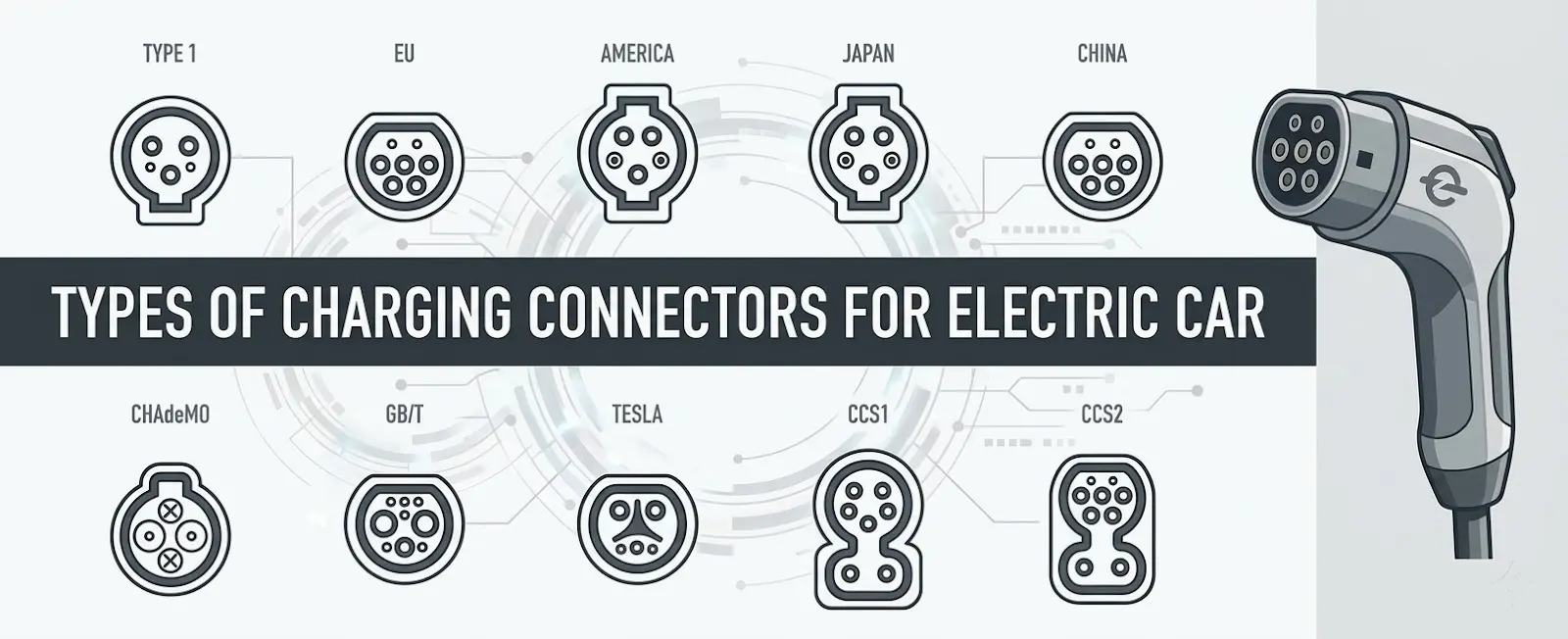
| Connector Type | Primary Region | Charging Mode | Key Features & Description |
|---|---|---|---|
| Type 1 (J1772) | North America | AC (Level 1 & 2) | Single-phase plug with 5 pins. Common on earlier EV models and used for home/public AC charging. |
| Type 2 (Mennekes) | Europe | AC | 7-pin standard supporting both single-phase and three-phase AC. Highly versatile and used globally outside North America. |
| CCS1 (Combined Charging System) | North America / Asia | AC & DC Fast | Combines a Type 1 AC connector with two large DC pins. Allows a single port to handle both AC and DC fast charging. |
| CCS2 | Europe | AC & DC Fast | The European equivalent of CCS1. It integrates a Type 2 AC connector with two large DC pins; a leading global standard. |
| CHAdeMO | Japan | DC Fast | Developed in Japan. Known for bidirectional charging capabilities (powering the grid from the car). |
| GB/T (AC) | China | AC | The national standard for AC charging in China; requires an adapter for use in other regions. |
| GB/T (DC) | China | DC Fast | Mandatory for all new EVs sold in China. China and Japan are currently co-developing a successor called ChaoJi. |
| Tesla (NACS) | North America | AC & DC | A proprietary, sleek, and compact design. Now renamed the North American Charging Standard (NACS) as other automakers adopt it. |
The Engineering Reality of EV Charging Adapters
An EV charging adapter is not a simple pass-through cable; it is a critical component in a high-voltage electrical circuit. To function safely, an adapter must maintain precise physical tolerances, manage immense thermal loads, and successfully facilitate digital handshakes between the charger and the vehicle’s battery management system (BMS).
AC vs. DC Adapters: Different Stakes
The safety profile of an adapter shifts dramatically depending on the power output:
- AC Adapters: Used primarily for destination or overnight charging, these adapters handle lower power loads (typically up to 19.2 kW). While generally safer, sustained daily use requires robust internal contacts to prevent gradual heat buildup. If your facility relies on AC charging for employee or fleet parking, adapter durability is a key operational metric.
- DC Fast Charging Adapters: The stakes are exponentially higher here. Modern DC charging stations can deliver up to 1000V and 500A. At these levels, any resistance caused by poor adapter construction will result in rapid, dangerous overheating.
Key Safety Risks of Substandard Adapters
While certified, automaker-approved adapters are generally safe, the market is flooded with low-cost, uncertified alternatives. Deploying or allowing these on your commercial infrastructure introduces severe liabilities.
- Thermal Runaway and Overheating: High-current charging tests an adapter’s thermal management. Budget adapters often list peak power ratings rather than continuous load capacities. Over extended sessions, inadequate conductive paths will overheat, potentially melting the adapter or damaging the vehicle inlet.
- Mechanical Wear and Poor Tolerances: Frequent plugging and unplugging wear down connector pins. Substandard materials degrade faster, leading to a loose fit. Without a snug connection, electrical resistance spikes, causing dangerous arcing and voltage drops.
- Failure of Safety Interlocks: Premium charging infrastructure relies on sophisticated power electronics—from the heavy-duty contactors down to the bridge rectifiers managing core power conversion. If an adapter fails to properly transmit the safety handshake between the car and the charger, the system may fail to cut power during a fault, leading to catastrophic equipment damage.
- Lack of Environmental Sealing: Commercial stations are exposed to rain, snow, and dust. Non-rated adapters lack the necessary IP54 or IP65 weatherproofing to prevent moisture from causing short circuits.
Certification is Non-Negotiable
For B2B buyers and network operators, regulatory compliance is the ultimate filter for adapter safety. Never permit or purchase adapters that lack verifiable certifications from recognized testing laboratories.
- UL 2251: The safety standard specifically governing adapters for AC charging couplers.
- UL 2252: A newer, highly stringent standard designed to evaluate DC fast-charging adapters, ensuring they can withstand massive continuous power loads, drop tests, and extreme temperatures.
- CE and IEC 62196: Essential compliance markers for European and international markets, guaranteeing adherence to strict safety and electromagnetic interference regulations.
Best Practices for Fleet Managers and CPOs
To mitigate risks while accommodating diverse EV models, implement these infrastructure strategies:
- Prioritize Native Connectors: The safest adapter is no adapter. When building out a network of EV chargers, source equipment that natively supports the connector standards dominant in your operational region.
- Enforce Approved Equipment Policies: If adapters must be used on your hardware, strictly restrict usage to OEM-manufactured or UL-certified models.
- Implement Preventative Maintenance: Regularly inspect public and fleet charging connectors for signs of thermal warping, cracked housings, or blackened pins caused by faulty customer adapters.
- Leverage Smart Energy Management: Utilize charging stations with advanced software platforms that monitor cable temperature and automatically derate power if abnormal heat is detected at the connector interface.