
 Deutsch
  Español
  Français
  Italiano
  Português
  Svenska
  Suomi
Suomi  Dansk
Dansk  Norsk bokmål
  Nederlands
  العربية
  עברית
עברית  Polski
  Türkçe
  Русский
  Uzbek
Uzbek  Azərbaycan
  Tiếng Việt
  ไทย
ไทย  한국어
한국어  日本語
日本語  简体中文
简体中文 
As the global transition toward electric mobility accelerates, the demand for reliable, scalable electric vehicle (EV) charging infrastructure has never been higher. For charge point operators (CPOs), fleet managers, and real estate developers, understanding the core hardware standards is critical to deploying successful networks. One of the most common technical crossroads encountered in project planning is understanding the distinction between Type 1 vs. Type 2 EV chargers.
While both connector types are designed to deliver alternating current (AC) to an electric vehicle’s onboard charger, their underlying engineering, power delivery capabilities, and geographic adoption vary significantly. In this guide, we will break down the fundamental differences between Type 1 and Type 2 EV chargers and explore what these distinctions mean for your commercial EV charging investments.
The Fundamentals of AC Charging Connectors
Before diving into the specifics of Type 1 vs. Type 2 EV chargers, it is essential to understand that both standards primarily govern AC power delivery. Because the electrical grid supplies AC power, and EV batteries store direct current (DC) power, the vehicle’s onboard charger handles the conversion. High-quality AC chargers provide the smart wallboxes and commercial charging points necessary to deliver this energy safely and efficiently to the vehicle.
What is a Type 1 EV Charger (SAE J1772)?
The Type 1 connector, formally known as the SAE J1772 standard, is a 5-pin plug widely adopted in North America and Japan.
- Power Delivery: Type 1 is strictly a single-phase connector.
- Output Capacity: It typically supports power outputs ranging from 3.7 kW up to 7.4 kW (and occasionally up to 19.2 kW in specific North American commercial setups).
- Design Features: It includes a physical latch mechanism to secure the plug to the vehicle, preventing accidental disconnections.
What is a Type 2 EV Charger (Mennekes / IEC 62196)?
The Type 2 connector, often referred to as the Mennekes plug, is a 7-pin plug that has become the universal standard across Europe and most other global markets.
- Power Delivery: Unlike Type 1, Type 2 connectors support both single-phase and three-phase power.
- Output Capacity: On a single-phase supply, it can deliver up to 7.4 kW. However, when connected to a three-phase commercial power supply, Type 2 chargers can push up to 22 kW (and in rare cases, up to 43 kW for early fast-charging setups).
- Design Features: Instead of a manual physical latch, Type 2 connectors utilize an automated electronic locking pin mechanism, securing the cable automatically when the charging session begins.
Key Differences: Type 1 vs. Type 2 EV Chargers
To optimize your commercial charging rollout, here is a comparative breakdown of the two standards:
- Phase Capability & Charging Speed: The most significant operational difference is phase support. Type 1 is limited to single-phase grid connections, resulting in longer charging times. Type 2 supports three-phase power, allowing for significantly faster energy transfer—a major advantage for commercial fleets and destination charging.
- Global Geography: If you are sourcing equipment for North America or Japan, Type 1 compatibility is essential (though NACS is also shifting the North American landscape). If your deployments are in Europe, Asia-Pacific, or the Middle East, Type 2 is the mandatory standard.
- Pin Configuration: The Type 1 5-pin layout includes two power pins, an earth pin, and two communication pins. The Type 2 7-pin layout adds two extra power pins to accommodate the three-phase AC power lines.
- Locking Mechanisms: The electronic locking system of the Type 2 connector provides a distinct security advantage for public charging stations, protecting against cable theft and unauthorized tampering during active sessions.
Beyond AC: The Evolution to High-Power Charging
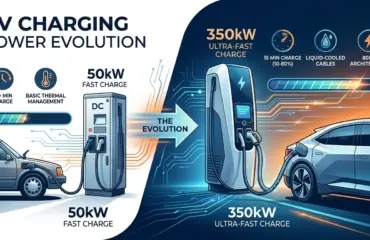
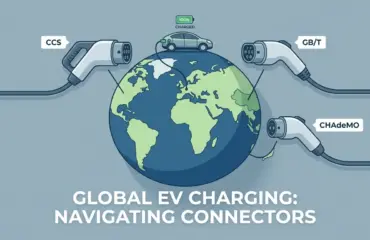
While understanding Type 1 and Type 2 connectors is essential for AC destination charging, high-turnover locations require rapid energy delivery. This is where DC Fast Charging takes over. DC chargers bypass the vehicle’s onboard converter, delivering direct current straight to the battery using Combined Charging System (CCS) standards—CCS1 (building on Type 1) and CCS2 (building on Type 2).
Delivering high-voltage DC power requires advanced internal architecture. At the heart of these industrial-grade stations are heavy-duty semiconductor components, such as high-efficiency bridge rectifiers, which handle the intense power conversion from the grid’s AC supply to the vehicle’s DC battery. Partnering with a manufacturer that possesses a deep heritage in power semiconductors ensures long-term reliability and minimal downtime.
Choosing the Right Hardware with PandaExo
Deciding between Type 1 and Type 2 EV chargers ultimately depends on your regional market requirements and electrical grid infrastructure. Regardless of the standard, commercial success in the EV sector requires hardware that is intelligent, durable, and scalable.
As a global leader in smart EV charging solutions, PandaExo operates a 28,000-square-meter advanced manufacturing base to provide factory-direct scale and engineering precision. Whether you are looking for smart AC charging points for a residential complex, rapid DC stations for a highway corridor, or custom OEM/ODM solutions, we deliver high-performance hardware backed by robust smart energy management platforms.
Are you ready to build the future of mobility? Browse our comprehensive EV charging infrastructure catalog to find the perfect fit for your next project, or explore our full range of products to experience the ultimate in factory-direct power and precision.