
 Deutsch
  Español
  Français
  Italiano
  Português
  Svenska
  Suomi
Suomi  Dansk
Dansk  Norsk bokmål
  Nederlands
  العربية
  עברית
עברית  Polski
  Türkçe
  Русский
  Uzbek
Uzbek  Azərbaycan
  Tiếng Việt
  ไทย
ไทย  한국어
한국어  日本語
日本語  简体中文
简体中文 
The EV charging market in 2026 is entering a more disciplined phase. Growth is still strong, but buyers are no longer judging projects mainly by charger count or nameplate power. They are looking harder at uptime, software flexibility, grid readiness, fleet suitability, and whether a charging deployment will still make commercial sense three to five years from now.
For operators, installers, distributors, and manufacturers, that shift matters. The next wave of winners will not simply install more chargers. They will build charging systems that are better matched to site behavior, easier to manage, and more resilient as standards, utility requirements, and operating models keep changing.
The 2026 Market at a Glance
Before looking at each trend in detail, it helps to see where the market pressure is moving.
| Market Shift | What Buyers Are Really Asking | Why It Matters |
|---|---|---|
| Interoperability | Can this charger and software stack adapt over time? | Reduces lock-in risk and protects future migration options |
| Smarter power planning | Is the charger mix right for the site, not just impressive on paper? | Improves utilization, economics, and deployment fit |
| Energy management | Can the site control load intelligently? | Helps avoid unnecessary upgrades and peak-cost exposure |
| Utility coordination | Can the project get energized on a realistic timeline? | Delays often come from grid constraints, not hardware lead times |
| Fleet readiness | Will this infrastructure support route-critical operations? | Depot and fleet use cases punish weak design and weak support |
| Uptime strategy | How quickly can faults be detected and resolved? | Revenue, customer trust, and service quality depend on it |
| Distributed energy integration | Is the site ready for storage, solar, or bidirectional use later? | Improves long-term flexibility even when full deployment is phased |
Trend 1: Interoperability Is Becoming a Procurement Requirement
Closed charging ecosystems are becoming harder to justify. Commercial buyers increasingly want the freedom to change software providers, scale across mixed hardware environments, or integrate charging into a larger site operations strategy.
That is why open standards are moving beyond engineering preference and into procurement language. A charger that cannot support operational flexibility may still work technically, but it creates commercial risk later. PandaExo’s article on OCPP and commercial EV stations shows why interoperability now functions as a hedge against migration cost, software dependency, and platform lock-in.
Trend 2: Power Level Alone Is No Longer the Main Story
The market still values faster charging, but buyers are becoming more selective about where high power actually produces a return. In many projects, the better question is not “What is the highest kW available?” but “What charger mix fits this site’s dwell time, turnover pattern, and grid reality?”
That is changing how teams think about portfolio design. The evolution of fast charging power levels still matters, but high power is no longer the whole strategy. In 2026, strong infrastructure planning often combines AC and DC charging rather than forcing one power class to solve every use case.
| Site Type | What Often Matters More Than Maximum kW | Typical Planning Logic |
|---|---|---|
| Workplace or destination charging | Dwell time, load control, user scheduling | AC charging may deliver better economics and easier scaling |
| Retail or hospitality | Session turnover, convenience, utility cost | Charger speed must align with actual customer stop duration |
| Public highway or corridor sites | Throughput, queue management, high availability | Higher-power DC charging is often justified |
| Fleet and depot sites | Route predictability, uptime, operational windows | Power design must match duty cycles and depot workflow |
Trend 3: Energy Management Is Now a Competitive Differentiator
As charger density grows, energy management is becoming a core part of infrastructure value. Buyers want more than the ability to deliver power. They want visibility into how that power is distributed, prioritized, and monetized across a site or portfolio.
For mixed-use commercial environments, the biggest advantage is often not raw charging speed. It is the ability to manage load intelligently enough to delay service upgrades, reduce demand-charge exposure, and preserve expansion options.
This is one reason why software, controls, and charger behavior are being evaluated together rather than in separate procurement tracks.
Trend 4: Utility and Grid Coordination Is Moving Earlier in the Project Cycle
One of the clearest changes in 2026 is that project teams are engaging utilities earlier. Installers and developers have learned that transformer constraints, interconnection timing, and distribution capacity can determine project success just as much as hardware delivery.
That is changing project sequencing. Buyers are spending more time on make-ready assessment, staged energization plans, and site power modeling before finalizing equipment mix. The commercial effect is simple: charger selection is becoming more tightly tied to grid reality.
| Project Factor | Older Mindset | 2026 Mindset |
|---|---|---|
| Utility engagement | Often started after equipment decisions | Starts earlier and influences charger mix |
| Power availability | Assumed to be solvable later | Treated as a primary planning constraint |
| Upgrade timing | Considered a separate issue | Built into rollout phasing and budget logic |
| Site design | Hardware-first | Utility-informed and staged for expansion |
Trend 5: Fleet and Depot Charging Is Driving More Disciplined Infrastructure Design
Fleet electrification is pushing the market toward more operational rigor. Depot charging projects are less forgiving than casual public deployments because missed charging windows can affect route readiness, labor scheduling, and service continuity.
That means fleet buyers are placing greater weight on predictable power delivery, clear support ownership, and infrastructure that aligns with daily operating behavior rather than theoretical charging potential. In practice, this leads to more deliberate charger placement, stronger control requirements, and more serious expectations around service response.
Trend 6: Uptime and Support Are Gaining Strategic Importance
In a more mature charging market, uptime is no longer just a maintenance metric. It is part of the product. Site hosts, CPOs, and fleet operators increasingly care about remote diagnostics, firmware governance, escalation discipline, and how quickly a charger can be returned to service after a fault.
A charger that is technically installed but commercially unreliable creates a weak customer experience and a weak asset. This is especially true for paid public charging, workplace charging commitments, and route-critical fleet use cases.
For manufacturers and OEM partners, that shifts the conversation from hardware shipment alone to lifecycle supportability.
Trend 7: Solar, Storage, and Bidirectional Thinking Are Getting More Practical
Distributed energy is not the right choice for every charging project, but it is moving from concept to practical planning in the right contexts. Buyers are showing stronger interest in solar-assisted charging, storage-backed peak shaving, and infrastructure that can support future bidirectional strategies.
This is closely related to the broader discussion around vehicle-to-grid and grid stability. Even where V2G is not immediately deployed, the commercial logic behind smarter grid interaction is already shaping specification decisions.
What Commercial Buyers Should Do With These Trends
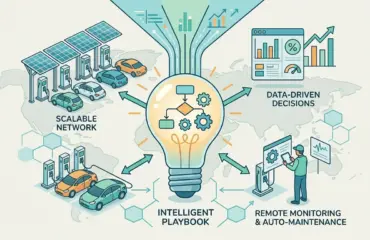
The practical takeaway is that charging infrastructure should now be evaluated as a system, not a standalone product purchase. In 2026, strong deployments are usually the ones where charger type, software openness, utility profile, support model, and user behavior are aligned before procurement is finalized.
Buyers should pressure-test projects against the following questions.
| Buyer Question | Why It Should Be Asked Early |
|---|---|
| Can this deployment remain flexible if software or network strategy changes? | Protects against platform lock-in and rework |
| Is the charger mix matched to real session behavior? | Improves ROI and avoids overbuilding |
| How will load be managed as site utilization grows? | Helps control power cost and expansion risk |
| What utility constraints could delay commissioning? | Reduces rollout surprises and budget drift |
| Who owns support escalation, diagnostics, and field service? | Clarifies uptime accountability |
| Is the hardware suitable for future portfolio expansion or customization? | Improves long-term fit for distributors, operators, and OEM channels |
How PandaExo Fits These Market Shifts
PandaExo is well aligned with where the market is moving because buyers increasingly want both charging hardware and operational intelligence. With AC and DC charging solutions, smart energy management capability, manufacturing scale, and OEM and ODM flexibility, PandaExo supports a more commercially grounded approach to EV infrastructure planning.
That matters for buyers who need infrastructure that is scalable across site types, supportable over time, and adaptable to changing market requirements instead of being optimized only for the first installation phase.
Final Takeaway
The most important EV charging trends in 2026 are not isolated technology headlines. They are signals that the market is becoming more operational, more selective, and more demanding about long-term flexibility.
If your business is planning its next charging phase and wants infrastructure choices that reflect where the market is heading, PandaExo can help you evaluate practical AC and DC solutions for real deployment conditions. Contact the PandaExo team to discuss a future-ready charging strategy.