
 Deutsch
  Español
  Français
  Italiano
  Português
  Svenska
  Suomi
Suomi  Dansk
Dansk  Norsk bokmål
  Nederlands
  العربية
  עברית
עברית  Polski
  Türkçe
  Русский
  Uzbek
Uzbek  Azərbaycan
  Tiếng Việt
  ไทย
ไทย  한국어
한국어  日本語
日本語  简体中文
简体中文 
Stable DC output is one of the quiet requirements behind reliable EV infrastructure. Operators usually notice charging speed, uptime, software visibility, and service responsiveness. Underneath all of that, however, power quality decisions in the conversion stage often determine whether a charger performs consistently or turns into a recurring field issue.
One of the most important of those decisions is smoothing capacitor sizing. When the capacitor is undersized, ripple rises, downstream electronics work harder, and thermal stress increases. When it is oversized, startup inrush current, cost, enclosure space, and protection coordination can all become harder to manage. For charger manufacturers, OEM teams, and infrastructure engineers, getting this calculation right is a basic but high-value design discipline.
Why Rectification Still Needs Smoothing
A rectifier converts AC input into DC, but the first output is not flat DC. It is pulsating DC with voltage variation between peaks. The smoothing capacitor sits across the load and acts as an energy buffer. It charges near the waveform peaks and discharges between them, reducing ripple and stabilizing the output seen by the rest of the circuit.
In EV charging and related power electronics, this matters because downstream stages depend on a predictable DC bus. A weak smoothing strategy can create avoidable instability long before a system reaches catastrophic failure.
| Stage | What It Does | Why It Matters in EV Infrastructure |
|---|---|---|
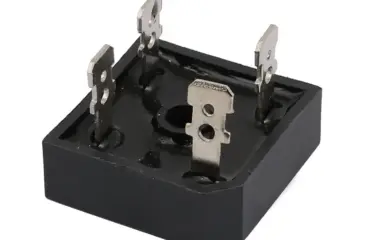
| Rectifier | Converts AC input into pulsating DC | Creates the base DC supply for control electronics or power stages |
| Smoothing capacitor | Reduces voltage ripple between waveform peaks | Helps protect converters, logic boards, and sensitive loads from unstable DC |
| Downstream converter or controller | Uses the DC supply for regulation and power delivery | Performs better when the DC input is clean and predictable |
If your team is reviewing the broader conversion chain, PandaExo’s article on how a bridge rectifier circuit works is a useful companion reference.
Why Capacitor Sizing Is a Business Decision, Not Just a Math Exercise
Capacitance selection affects more than waveform quality. In B2B power electronics, it also influences bill of materials, startup behavior, thermal performance, enclosure size, and long-term serviceability.
This is especially relevant in applications connected to EV charging infrastructure, where power quality problems can propagate into larger operational issues.
| Sizing Choice | Immediate Electrical Effect | Operational Consequence |
|---|---|---|
| Capacitor too small | Higher ripple voltage | Greater stress on converters, more noise, and less stable output |
| Capacitor too large | Higher inrush current at startup | Increased stress on the rectifier, breakers, and soft-start strategy |
| Correctly sized capacitor | Ripple kept within design limits | Better balance between electrical stability, protection, cost, and packaging |
In charging systems, that balance supports better uptime, cleaner regulation, and fewer avoidable service events.
The Core Formula for Smoothing Capacitor Calculation
For a standard full-wave rectifier, the sizing relationship can be expressed in plain form as:
C = I / (2 × f × Delta-V)
Where:
| Variable | Meaning | Typical Unit |
|---|---|---|
C |
Required capacitance | Farads |
I |
Continuous load current | Amperes |
f |
AC supply frequency | Hertz |
Delta-V |
Maximum allowable peak-to-peak ripple voltage | Volts |
2 |
Accounts for full-wave rectification producing two charging pulses per cycle | Dimensionless |
For a half-wave rectifier, the pulse frequency is lower, so that factor changes and the required capacitor value increases for the same ripple target.
This is one reason full-wave rectification remains the more practical option for most serious power electronics designs.
How to Think About Each Variable
The formula itself is simple. The quality of the result depends on whether each input reflects the real operating condition.
| Input | Design Question to Ask | Common Mistake |
|---|---|---|
| Load current | What is the real continuous current, not just a nominal target? | Using ideal or average current while ignoring peaks or continuous operation |
| Grid frequency | Is the system designed for 50 Hz, 60 Hz, or both? | Forgetting that frequency changes ripple behavior and required capacitance |
| Ripple allowance | How much ripple can the downstream stage actually tolerate? | Choosing an arbitrary ripple target without checking converter or control sensitivity |
| Voltage rating margin | What DC voltage and transients will the capacitor actually see? | Sizing capacitance correctly but choosing an unsafe voltage rating |
In practice, capacitor selection is rarely just about the computed capacitance number. Engineers also need to review voltage headroom, temperature rating, ESR, ripple current capability, lifetime expectations, and mechanical packaging.
Step-by-Step Example
Assume an internal DC supply inside a charger subsystem or control assembly with the following design targets:
- Load current: 5 A
- AC input frequency: 50 Hz
- Maximum ripple voltage: 1.5 V
Using the full-wave formula:
C = 5 / (2 × 50 × 1.5)
First simplify the denominator:
2 × 50 × 1.5 = 150
Then divide:
C = 5 / 150 = 0.0333 F
Convert to microfarads:
0.0333 F = 33,300 uF
In a practical design, an engineer would usually choose the next suitable standard value above that result, while also verifying voltage margin and ripple-current capability.
| Example Parameter | Value |
|---|---|
| Load current | 5 A |
| Frequency | 50 Hz |
| Allowable ripple | 1.5 V |
| Calculated capacitance | 0.0333 F |
| Equivalent in microfarads | 33,300 uF |
| Practical next-step decision | Select a standard value above the minimum and verify voltage and thermal margin |
What the Calculation Does Not Tell You
The formula gives a minimum capacitance estimate under simplified assumptions. It does not automatically confirm that the chosen capacitor bank will survive the real environment.
Before release, teams should still evaluate:
- Voltage rating relative to the expected DC bus and transient conditions
- Ripple current capability under continuous operation
- ESR and resulting self-heating
- Temperature rise inside the enclosure
- Mechanical space and mounting approach
- Inrush current impact on the rectifier and protection devices
That last point is especially important. If the capacitor bank is large, startup behavior can become a separate engineering problem. This is one reason rectifier robustness still matters in charger architecture. PandaExo’s article on why high-quality rectifier diodes are critical is relevant when evaluating that interaction.
Full-Wave vs. Half-Wave Rectification in Capacitor Sizing
The rectification topology directly affects ripple frequency and capacitor demand. That changes both electrical efficiency and cost structure.
| Factor | Half-Wave Rectifier | Full-Wave Rectifier |
|---|---|---|
| Output pulses per AC cycle | 1 | 2 |
| Ripple frequency | Equal to input frequency | Double the input frequency |
| Required capacitor for same ripple target | Larger | Smaller |
| Conversion efficiency | Lower | Higher |
| Suitability for EV power electronics | Limited to simpler low-power use cases | Better suited to serious charger and converter designs |
If the goal is stable output with more efficient use of the AC waveform, full-wave design is usually the better engineering and commercial choice.
Where This Matters in EV Charging Systems
Smoothing capacitor decisions show up in more places than the main charging path. They can influence:
- Internal low-voltage supplies for control electronics
- Auxiliary power rails in smart charging systems
- Power conditioning stages inside charger modules
- Support circuits around rectifiers and converters
In high-power DC charging environments, poor ripple control can increase thermal stress and reduce confidence in long-term reliability. In AC charging equipment, stable support circuitry still matters because software, communication, metering, and protection logic all depend on a dependable DC supply.
For teams focused specifically on ripple behavior, PandaExo’s guide to minimizing ripple voltage in automotive power delivery adds useful design context beyond the basic sizing equation.
A Practical Selection Checklist
Before finalizing the capacitor bank, use a quick design review like this:
| Checkpoint | Why It Should Be Confirmed |
|---|---|
| Capacitance meets the ripple target | Confirms the basic output-stability requirement |
| Voltage rating includes safe headroom | Prevents premature failure from normal peaks or transients |
| Ripple current rating is sufficient | Avoids internal heating and shortened service life |
| ESR is acceptable for the design | Helps control heat and voltage ripple under load |
| Inrush current is managed | Protects the rectifier, breakers, and startup sequence |
| Thermal environment is validated | Ensures the chosen solution survives real enclosure conditions |
| Mechanical fit is practical | Avoids redesign pressure late in the packaging stage |
This kind of checklist is often what separates a correct paper design from a production-ready one.
Why PandaExo Is Relevant to This Discussion
Capacitor sizing is only one part of power-stage reliability, but it sits inside a larger ecosystem of rectifiers, conversion hardware, thermal management, and system-level charger design. PandaExo’s relevance comes from that broader integration: EV charging solutions, smart platform capability, factory-direct scale, and deep experience in power semiconductors.
For OEM teams, channel partners, and infrastructure buyers, that combination supports more than product sourcing. It supports more confident decisions around power-stage quality, manufacturing consistency, and long-term field performance.
Final Takeaway
Calculating the smoothing capacitor value for a rectifier circuit starts with a simple equation, but the engineering decision does not end there. The right capacitance must also fit ripple targets, voltage margin, ripple current, inrush control, thermal conditions, and packaging constraints.
For EV infrastructure, getting that balance right helps protect uptime, power quality, and downstream component life. If your team is evaluating charger hardware, semiconductor components, or OEM and ODM support for robust EV power systems, contact the PandaExo team to discuss a solution aligned with real operating requirements.