
 Deutsch
  Español
  Français
  Italiano
  Português
  Svenska
  Suomi
Suomi  Dansk
Dansk  Norsk bokmål
  Nederlands
  العربية
  עברית
עברית  Polski
  Türkçe
  Русский
  Uzbek
Uzbek  Azərbaycan
  Tiếng Việt
  ไทย
ไทย  한국어
한국어  日本語
日本語  简体中文
简体中文 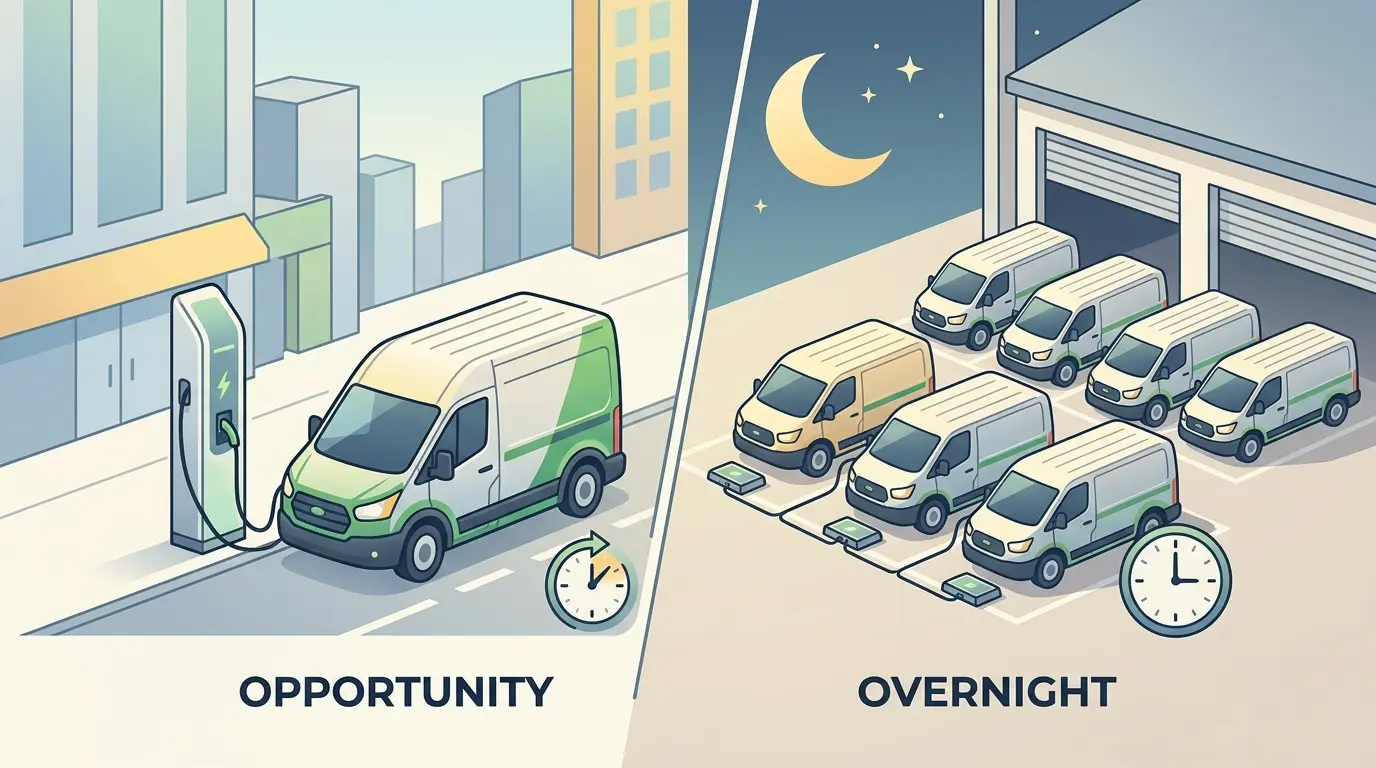
For fleet operators, the real charging question is rarely how fast a charger can deliver energy on paper. It is whether the charging model fits vehicle dwell time, route pressure, site power limits, and expansion plans without creating a new operational bottleneck.
That is why the debate between opportunity charging and overnight charging matters. One strategy pushes energy into short windows during the workday. The other uses long parked periods to restore vehicles more gradually. Both can work. Neither scales well when it is applied to the wrong duty cycle.
The better fleet strategy usually comes down to what the operation is optimizing for: minimum infrastructure complexity, maximum vehicle utilization, tighter dispatch resilience, or a balanced path between all three.
What Opportunity Charging and Overnight Charging Actually Mean
Opportunity charging means adding energy whenever a vehicle has a short but usable dwell window during the day. That can happen at a depot between shifts, at a route layover, at a logistics hub, or at a terminal where vehicles pause long enough to recover meaningful range.
Overnight charging uses longer parked periods, most often at a depot or assigned parking area, to replenish the vehicle outside active service hours. In many fleet environments, this aligns naturally with AC smart charging, where vehicles do not need rapid turnaround and the operator can manage power across multiple bays.
The difference is not only about charging speed. It is about how the fleet uses time.
| Strategy | Typical Dwell Window | Primary Goal | Common Infrastructure Fit |
|---|---|---|---|
| Opportunity charging | Minutes to a few hours during operations | Protect vehicle uptime and route continuity | Often DC fast charging, sometimes targeted higher-power charging |
| Overnight charging | Several hours when vehicles are parked off shift | Restore daily energy need at lower operational pressure | Usually managed AC charging, with selective DC where needed |
Why Overnight Charging Usually Scales More Easily at the Start
If the fleet has predictable return-to-base behavior, overnight charging is usually the easier model to scale first. It aligns with lower operational stress, simpler site scheduling, and more manageable electrical planning.
That is because overnight charging lets the operator use time as a resource. Vehicles are already parked. Energy can be distributed across the full off-shift window instead of being forced into a short service gap. That often reduces the need for high-power hardware, lowers simultaneous peak demand, and makes phased site growth easier to control.
From a scaling perspective, overnight charging often performs well in these areas:
- Lower power concentration at a single moment
- Easier alignment with depot-based operations
- More room for smart scheduling and staggered charging
- Lower risk of disrupting dispatch when a charger is temporarily unavailable
- Simpler expansion path for fleets adding vehicles gradually
This does not make overnight charging universally better. It means it is often the more forgiving foundation when the fleet has long dwell and the business wants to avoid overbuilding too early.
Why Opportunity Charging Can Scale Better in High-Utilization Fleets
Opportunity charging becomes more attractive when the fleet cannot afford long idle windows. Transit fleets, airport shuttles, high-mileage delivery routes, and other high-utilization operations may not have enough overnight dwell to restore all required energy without reducing vehicle availability or increasing battery oversizing.
In those cases, targeted DC charging can scale better because it supports the business model the fleet is actually running. The goal is not to charge everywhere, all the time. The goal is to place fast energy recovery exactly where operational pressure exists.
Opportunity charging can improve scale economics when it helps the fleet:
- Keep more vehicles in active rotation
- Reduce the need for spare vehicles held only for charging downtime
- Avoid excessively large battery packs chosen mainly to survive long service windows
- Maintain service continuity across multi-shift or near-continuous operations
But the scaling advantage only holds if the charging windows are real and repeatable. If the operation depends on short breaks that frequently disappear, opportunity charging can become fragile. A delayed route, a queue at the charger, or a site outage can quickly affect dispatch performance.
The Real Scaling Test Is Not Charger Count. It Is System Pressure.
Many fleet teams compare strategies by asking which one needs more chargers. That is too narrow. The more useful question is which model puts less pressure on the whole system as the fleet grows.
That system pressure includes:
- Utility capacity and upgrade lead times
- Peak load concentration
- Parking layout and vehicle flow
- Charger utilization balance across the day
- Route recovery tolerance if one charger goes offline
- Software visibility into vehicle priority and state of charge
An overnight model may need more connected bays, but those bays can often run under managed power caps. An opportunity model may need fewer charge points, but each one can carry far more operational dependency. Scaling is not just about hardware quantity. It is about how failure, queuing, and power demand behave under growth.
Overnight Charging Wins on Simplicity, but Not Always on Throughput
For fleets with stable dwell windows, overnight charging is often the most practical way to scale from pilot to full deployment. It is well suited to municipal depots, service fleets, light commercial vehicles, and many workplace-based operations where vehicles return to the same site each evening.
Its biggest advantage is control. Operators can use scheduling logic, tariff-aware charging windows, and dynamic load management principles to spread demand across the night rather than sizing infrastructure around worst-case simultaneous output.
Its main limitation is throughput. If more vehicles are added, route mileage rises, or shift structures tighten, the overnight window may stop being large enough. At that point, the fleet either needs more site power, more available charging positions, longer dwell, or a second charging layer during the day.
That is the moment when overnight-only planning can stop scaling cleanly.
Opportunity Charging Wins on Asset Utilization, but It Raises Site Complexity
Opportunity charging can scale very effectively in fleets where uptime is the core constraint. If a vehicle only has a brief mid-day pause, fast energy delivery may protect route continuity better than adding more vehicles or accepting lower utilization.
Still, the price of that flexibility is complexity. Opportunity charging often concentrates load into fewer locations, tighter time windows, and more operationally sensitive charging events. That changes how the site must be designed.
| Scaling Factor | Overnight Charging | Opportunity Charging |
|---|---|---|
| Site power profile | More spread out and schedulable | More concentrated and time-sensitive |
| Dispatch dependency on each charger | Usually lower | Usually higher |
| Fit for depot-return fleets | Strong | Situational |
| Fit for multi-shift or near-continuous fleets | Limited without support layers | Stronger when dwell windows are dependable |
| Infrastructure complexity | Often lower at initial rollout | Often higher from the start |
| Ability to absorb growth without redesign | Good if dwell remains long | Good if route pauses remain structured |
This is why opportunity charging should not be treated as a premium upgrade by default. It is a strategic fit for certain operating models, not a universal scaling shortcut.
Grid Capacity and Demand Charges Often Decide the Outcome
The fleet strategy that looks operationally elegant can still fail financially if the grid side is ignored. Opportunity charging often creates sharper peaks, especially if multiple vehicles need fast charging within the same period. Overnight charging usually offers more room to shape load and reduce those peaks.
That does not mean overnight charging is always cheaper overall. A fleet that relies only on slow overnight replenishment may need more parking infrastructure, more connectors, or larger service buffers in the vehicle schedule. But from an electrical planning perspective, it is usually easier to manage a long charging window than a short, high-power one.
Before choosing either model at scale, operators should test:
- Available utility capacity today
- Lead time for transformers or service upgrades
- Demand-charge exposure under peak charging events
- Whether software can prioritize only the vehicles that truly need immediate energy
- Whether the fleet may eventually need a mix of AC overnight charging and selective DC support
Those questions are why utility planning deserves to sit beside vehicle planning from the start. PandaExo’s broader infrastructure guidance on grid capacity, interconnection, and demand charges is relevant here because scaling problems often begin in the power model long before they appear in procurement.
The Best Large-Scale Strategy Is Often Hybrid, Not Pure
For many fleets, the most scalable answer is not choosing one strategy and rejecting the other. It is building overnight charging as the base layer and using opportunity charging only where duty cycles justify it.
That hybrid structure can look like this:
- Most vehicles replenish overnight on managed AC charging
- A smaller group of route-critical vehicles gets access to daytime fast charging
- Smart software prioritizes energy delivery by departure time and route importance
- The site is designed for phased growth rather than full build-out on day one
This model often scales better because it separates the fleet into charging jobs instead of forcing every asset into one energy pattern. It also gives operators more resilience. If a daytime fast charger is unavailable, the fleet still has an overnight replenishment layer. If overnight demand grows, the operator can protect key routes with targeted daytime recovery.
For suppliers with both hardware breadth and platform-level visibility, the advantage is not that fleets must buy every charger type. It is that the charging architecture can evolve with the fleet instead of locking the site into one operating assumption.
How To Choose Between the Two
The cleanest way to choose is to work through a short decision sequence:
- Map real dwell windows, not theoretical schedules.
- Separate vehicles by route pressure and daily energy need.
- Identify which vehicles can reliably wait until overnight and which cannot.
- Test whether managed overnight charging can cover typical and peak-day demand.
- Add opportunity charging only where the operation clearly benefits from fast recovery.
- Build the site for phased expansion so the charging mix can change as utilization changes.
If the fleet returns to base, has predictable off-shift parking, and can tolerate gradual replenishment, overnight charging usually scales better because it is operationally simpler and electrically easier to manage.
If the fleet runs long hours, has limited idle time, and depends on keeping vehicles in near-continuous service, opportunity charging may scale better because it protects utilization and route continuity more effectively than an overnight-only model.
Practical Summary
Overnight charging usually scales better when the fleet has time on its side. It is easier to schedule, easier to phase, and often easier to support with existing site power.
Opportunity charging usually scales better when the fleet has no time to spare. It can protect uptime and reduce idle assets, but it also increases the importance of charger placement, queue control, and power planning.
For most growing fleets, the strongest long-term strategy is not a strict choice between the two. It is a layered model that uses overnight charging for baseline energy delivery and opportunity charging for the smaller share of vehicles that genuinely need rapid recovery.
The strategy that scales best is the one that matches how vehicles actually move, park, and return to service. When fleet planners start from duty cycle and site constraints instead of charger labels, the charging network becomes easier to expand without adding unnecessary capital cost or operational risk.