
 Deutsch
  Español
  Français
  Italiano
  Português
  Svenska
  Suomi
Suomi  Dansk
Dansk  Norsk bokmål
  Nederlands
  العربية
  עברית
עברית  Polski
  Türkçe
  Русский
  Uzbek
Uzbek  Azərbaycan
  Tiếng Việt
  ไทย
ไทย  한국어
한국어  日本語
日本語  简体中文
简体中文 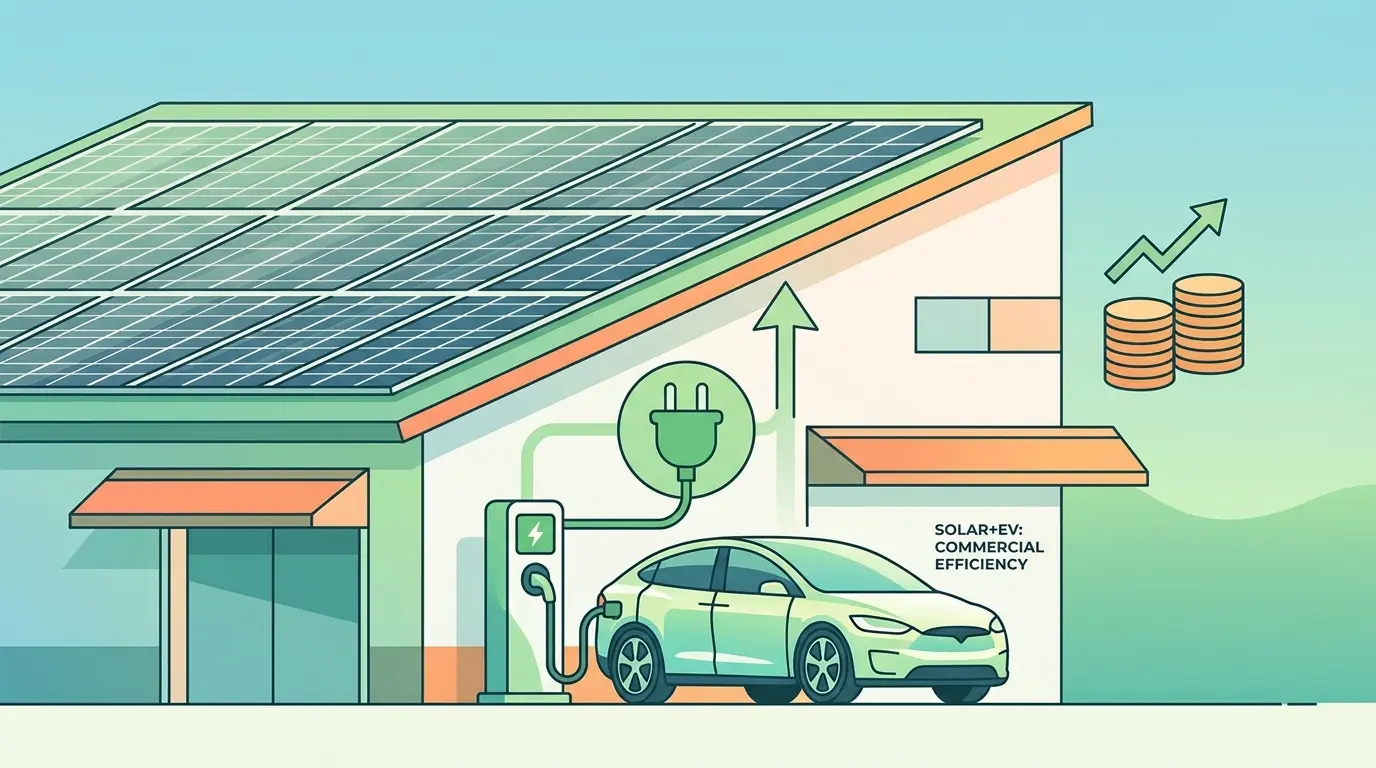
Putting solar next to EV charging sounds like an obvious win. Generate electricity on-site, send it to the chargers, reduce grid purchases, and improve the sustainability profile of the property. In practice, the economics are not that automatic.
The projects that work are usually not the ones built around a clean-energy narrative alone. They are the ones where charging demand, utility pricing, site layout, and capital cost line up closely enough that on-site generation reduces real operating expense instead of just improving appearances.
That is the real planning question. Not whether solar can support EV charging, but whether the site can use enough of that solar production at the right time, at the right cost, and with the right charger mix to produce a credible return.
The First Financial Test Is Load Overlap
Solar creates the strongest value when EV charging happens during solar production hours. That sounds simple, but it immediately separates strong business cases from weak ones.
Workplace parking, municipal fleets with daytime idle windows, service depots with predictable mid-shift returns, and some retail or destination sites often have better solar overlap because vehicles are parked and charging while the array is generating. Multifamily sites, overnight fleet depots, and residential-heavy charging patterns are different. Their demand usually rises after solar output has already dropped.
This is why the same solar system can look attractive on one site and underperform on another. If most charging occurs at night, the project may still work, but not because solar is directly serving the chargers in real time. At that point, the operator is relying on energy export credits, batteries, or broader site-energy savings to close the gap.
The Best Business Cases Usually Share the Same Conditions
When solar plus EV charging performs well financially, the project usually benefits from several value drivers at once rather than a single big advantage.
The most common conditions are:
- Charging sessions regularly occur between late morning and early evening.
- Local electricity tariffs make avoided daytime grid consumption valuable.
- The site has usable roof, canopy, or adjacent land without extreme structural or civil cost.
- Charger utilization is high enough that the solar system offsets real purchased energy rather than serving mostly idle hardware.
- Software controls can prioritize charging, stagger sessions, or cap grid draw when site demand spikes.
If only one of these conditions is present, the economics often become fragile. If three or four are present together, the project is much easier to justify.
| Site Profile | Financial Fit | Why It Can Work | What Usually Weakens the Case |
|---|---|---|---|
| Workplace parking | Strong | Long daytime dwell time aligns well with solar generation | Low charger utilization or employees charging mostly in the early morning and late evening |
| Municipal or service fleet depot | Strong to selective | Predictable schedules and controllable charging windows improve self-consumption | Weekend underuse, oversized solar, or poor route predictability |
| Retail or destination charging | Selective | Midday traffic can overlap with solar and improve utilization | Session volume is volatile and dwell time may be short |
| Multifamily charging | Weak to moderate | Shared-area energy savings may help if charging is partly daytime | Most vehicle demand is overnight |
| Highway or high-power corridor charging | Weak to selective | Large traffic flow can support charger revenue | Solar usually offsets only a small share of high-power DC demand unless land, storage, or incentives are unusually favorable |
Solar Reduces Energy Purchases Faster Than It Solves Peak Power Costs
Many buyers overestimate what solar will do for the most painful part of the charging bill. It often helps on energy volume before it helps on peak-demand exposure.
If the site uses moderate-power chargers across long dwell windows, solar can offset a meaningful share of imported electricity. If the site depends on fast charging bursts, the economics change. A vehicle that arrives and pulls high power immediately may still force substantial grid demand even if the array is producing at the same time. Cloud cover, charger concurrency, and uneven arrival patterns all make that harder to control.
That is why utility structure matters so much. If the tariff includes high demand charges, transformer constraints, or long interconnection timelines, the project needs to be evaluated as a full site-power design problem, not just a solar add-on. PandaExo’s guide to grid capacity, interconnection, and demand charges is useful here because the business case often depends as much on utility realities as on charger utilization.
In other words, solar can improve the operating cost picture without fully removing the need for load management, power sharing, or staged charging logic. Sites that ignore that distinction often assume the panels will solve a peak-demand problem they were never sized to solve.
AC Charging Usually Reaches Better Solar Alignment Than High-Power DC
From a pure matching perspective, lower-power charging often works better with solar than very high-power charging.
AC charging is typically associated with longer dwell time, more flexible session scheduling, and lower instantaneous load. That makes it easier to align vehicle charging with solar production throughout the day. A workplace, corporate campus, hotel, or mixed-use commercial property may find that moderate-power charging paired with good scheduling captures solar value more efficiently than a small number of high-power chargers that create short, sharp load events.
DC fast charging still has a place. It can make financial sense at fleet depots, logistics sites, retail corridors, and other locations where turnaround speed directly drives revenue or service continuity. But in most cases, solar is supporting only part of that fast-charging demand rather than carrying it. This is why a broader EV charger portfolio matters: the best solar-backed design is usually based on dwell time, charging priority, and operational need rather than a single charger class.
| Charging Model | Solar Match | Financial Logic |
|---|---|---|
| AC smart charging | Stronger | Lower power and longer dwell time improve solar self-consumption |
| Managed mixed AC deployment | Strong | Operators can shift charging across vehicles to follow solar production |
| Moderate-power DC for fleet recovery | Selective | Can work when fast turnaround has clear operational value |
| High-power public DC fast charging | Harder | Solar may offset only a limited share of very high peak demand |
The key is not that AC is always better than DC. It is that solar economics usually improve when charging can be spread across time instead of concentrated into short peaks.
Carports, Roofs, and Civil Work Often Decide the Real Payback
The solar array itself is only part of the capital equation. Structural design, parking-lot disruption, trenching, drainage changes, canopy steel, electrical routing, and permitting can turn a promising model into a marginal one.
This is especially true for retrofit sites. A property with available ground space or a structurally ready roof may install solar at a more favorable cost than a site that needs custom carports over active parking rows. On the other hand, a carport system can create stacked value by producing energy, shading vehicles, improving the customer experience, and making better use of already paved land. PandaExo’s article on solar carports for EV charging is relevant because canopy structure can either strengthen the business case or become the reason it stalls.
For some operators, the answer is to phase the project. Start with chargers and conduit planning, then add solar when the parking layout, structural design, or utilization data becomes clear enough to support the next investment step.
Incentives and Controls Can Move a Project From Marginal to Bankable
Many solar-plus-charging projects are not won by energy savings alone. They are won by stacked economics.
That stack may include avoided electricity purchases, tax credits, accelerated depreciation, local clean-energy grants, parking-asset improvement, tenant attraction, fleet-operating resilience, or the ability to defer part of a utility upgrade through better load control. If the project depends on only one narrow benefit stream, it becomes more sensitive to lower-than-expected utilization or policy changes.
Incentives deserve careful treatment. They can materially improve project payback, but they should strengthen a sound design, not rescue a weak one. PandaExo’s overview of EV charging station tax credits for businesses is a useful planning reference because the incentive structure often changes the timing and sequencing of procurement.
The same is true for energy controls. A site that can schedule charging, prioritize vehicles, and cap aggregate demand usually extracts more financial value from solar than a site that simply lets every charger pull as much power as possible whenever a vehicle plugs in.
When Solar Plus EV Charging Usually Makes Sense
The combination is usually strongest when the site owner can answer yes to most of the following questions:
- Do vehicles charge largely during solar production hours?
- Is grid electricity expensive enough that on-site generation displaces meaningful cost?
- Can the site install solar without unusually high structural or civil expense?
- Is charger utilization expected to be consistent rather than purely speculative?
- Can the charging system be managed intelligently instead of left fully uncontrolled?
- Are there additional financial supports such as incentives, parking upgrades, or tenant-retention benefits?
If most answers are yes, the project likely deserves serious financial modeling.
When the Combination Usually Does Not Make Sense Yet
There are also clear signals that the project is premature or wrongly configured.
- Charging demand is mostly overnight and the design does not include a credible storage or export-value strategy.
- The site wants high-power DC charging, but the available solar area is too small to affect operating cost materially.
- Charger utilization assumptions are based more on branding ambition than on real traffic, fleet activity, or tenant demand.
- Carport or structural retrofit cost is so high that solar savings alone cannot carry the capital burden.
- Demand charges, interconnection limits, or transformer upgrades remain the dominant cost issue and the design does not address them.
- The project is being justified as “free charging from the sun,” which is almost always too simplistic for commercial infrastructure planning.
In those cases, it may be smarter to phase the investment, start with managed charging, or prioritize chargers and site-power upgrades before solar.
Practical Summary
Solar plus EV charging makes financial sense when the project is built around operating reality, not just sustainability optics.
The strongest cases usually involve daytime charging demand, manageable installation cost, meaningful electricity savings, and enough software control to match charging behavior to solar production. Workplace parking, daytime fleet depots, and some destination-charging sites often fit that profile well. Multifamily overnight charging and very high-power public charging often require more caution because solar production and charging demand do not naturally line up.
The combination should be evaluated as a site economics problem, not a technology slogan. If the property can self-consume a meaningful share of solar output, control charging intelligently, and avoid overbuilding either the array or the charger power class, the numbers can work. If those conditions are missing, the better answer may be a phased infrastructure plan rather than a bundled solar-and-charging project on day one.