
 Deutsch
  Español
  Français
  Italiano
  Português
  Svenska
  Suomi
Suomi  Dansk
Dansk  Norsk bokmål
  Nederlands
  العربية
  עברית
עברית  Polski
  Türkçe
  Русский
  Uzbek
Uzbek  Azərbaycan
  Tiếng Việt
  ไทย
ไทย  한국어
한국어  日本語
日本語  简体中文
简体中文 
We understand the frustration. You plug in your electric vehicle at the end of a long day, expecting a full battery by morning, only to wake up to a tripped breaker and an uncharged car. Whether you are an individual EV owner, a property manager, or a fleet operator, an unreliable charging setup isn’t just an inconvenience—it translates directly to range anxiety, disrupted schedules, and lost productivity.
However, it is crucial to understand that a tripping breaker is not a malicious flaw; it is a critical safety mechanism doing exactly what it was designed to do: protecting your property from thermal damage and potential electrical fires.
As a global leader in EV infrastructure with a deep heritage in power semiconductors, PandaExo approaches these challenges through an engineering lens. Let’s break down the technical realities of why portable EV chargers frequently trip circuit breakers and explore the robust, commercial-grade solutions that eliminate this issue permanently.
Understanding the Root Cause: The Unique Demands of EV Charging
To diagnose the problem, we must first establish a fundamental truth about electric vehicles: EV charging is a continuous, high-draw electrical load. Most household or light-commercial appliances operate in cycles. Your refrigerator’s compressor kicks on and off; your microwave runs for two minutes. An EV charger, conversely, draws maximum current continuously for several hours. This sustained energy demand generates significant heat and places unprecedented stress on standard electrical infrastructure, exposing weaknesses that intermittent loads never would.
Here are the four primary technical reasons your portable EV charger is tripping the breaker.
1. The Continuous Load Rule (The 80% Rule)
The most common culprit behind a tripping breaker is a misunderstanding of electrical code requirements. Under the National Electrical Code (NEC), an EV charger is classified as a “continuous load” (defined as a maximum current expected to continue for three hours or more).
Because continuous loads generate sustained heat, safety regulations mandate that the circuit breaker and wiring must be rated for 125% of the charger’s maximum draw. Alternatively stated, your charger can only pull 80% of the breaker’s total capacity.
- If you have a 32-amp portable charger, it requires a dedicated 40-amp breaker.
- If you have a 40-amp portable charger, it requires a dedicated 50-amp breaker.
If you plug a 40-amp portable charger into a standard 40-amp circuit, the breaker will inevitably heat up and trip after a short period to prevent the wiring from melting.
2. Dual GFCI Conflicts (Nuisance Tripping)
Modern building codes often require Ground Fault Circuit Interrupter (GFCI) protection for 240V outlets situated in garages or outdoor locations. However, high-quality EV chargers already contain their own internal safety mechanism known as a Charge Circuit Interrupting Device (CCID), which acts as a specialized GFCI.
When you plug a portable charger into a GFCI-protected wall receptacle, you create a scenario with two competing safety devices on the same line. During the initial electrical “handshake” between the vehicle and the charger, minute amounts of current leakage are normal. While the EV charger’s CCID recognizes this as safe, the highly sensitive wall GFCI often misinterprets it as a fault and cuts the power. This is known in the industry as “nuisance tripping.”
3. Overloaded Shared Circuits
Portable chargers designed for standard 120V outlets (Level 1 charging) are frequently plugged into existing garage circuits. These circuits are rarely dedicated. If your EV charger shares a circuit with a garage freezer, overhead lighting, or power tools, the combined amperage will easily exceed the standard 15-amp or 20-amp limit. When the refrigerator compressor starts while the EV is charging, the sudden spike in current will immediately trip the breaker.
4. Hardware Degradation and Power Conversion Inefficiencies
A standard NEMA 14-50 receptacle is traditionally designed for electric ranges—appliances that are plugged in once and rarely moved. Portable EV chargers are frequently plugged and unplugged, which physically wears down the receptacle’s internal contacts. This wear increases electrical resistance, which in turn generates excessive heat. Once the heat travels back to the breaker panel, the thermal sensor inside the breaker trips.
Furthermore, the internal components of the charger matter. The process of converting and managing high-voltage electricity requires precise thermal management. In low-quality aftermarket portable chargers, inferior core power semiconductors and low-grade bridge rectifiers can result in poor energy conversion efficiency. This inefficiency bleeds off as excess heat, further compounding the strain on your electrical system.
Moving Beyond Portable: When It Is Time to Upgrade
Portable chargers, often referred to as “granny cables,” are intended for emergency use or temporary situations. Relying on them for daily, heavy-duty charging is a compromise on speed, safety, and reliability. If you are repeatedly experiencing tripped breakers, your infrastructure is signaling that it is time for a permanent, hardwired solution.
The Superiority of Hardwired AC Smart Charging
By transitioning to a dedicated, hardwired AC charging station, you eliminate the physical failure points of wall receptacles and bypass the nuisance tripping associated with dual GFCIs. Hardwired units establish a direct, secure connection to your electrical panel.
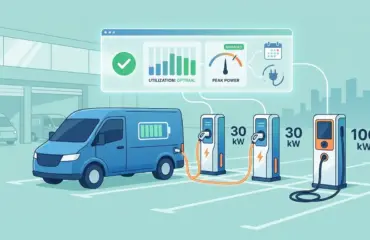
For commercial facilities, fleet operators, or forward-thinking homeowners, upgrading to AC smart charging stations offers advanced load balancing. Smart energy management platforms can dynamically distribute available power across multiple chargers, ensuring vehicles charge at optimal speeds without ever exceeding the facility’s total electrical capacity.
Scaling to DC Fast Charging
If your business requires rapid turnaround times—such as logistics fleets, highway charging hubs, or commercial parking structures—AC charging may not suffice. In these scenarios, DC fast charging infrastructure is the necessary next step. DC chargers bypass the vehicle’s onboard converter, delivering high-voltage direct current straight to the battery for exceptionally fast charging times, supported by heavily reinforced, commercial-grade electrical installations.
The PandaExo Advantage: Factory-Direct Precision
Solving EV charging challenges requires more than just replacing a breaker; it requires robust hardware built to withstand the realities of continuous energy demands.
At PandaExo, we operate a state-of-the-art 28,000-square-meter advanced manufacturing base. Backed by our deep heritage in power semiconductors, we engineer smart EV charging stations and energy management platforms that prioritize safety, efficiency, and longevity.
Whether you require a reliable home smart charger to permanently resolve nuisance tripping, or you are looking for customized OEM/ODM services to scale a commercial charging network, our factory-direct scale ensures precision at every level of the power electronics supply chain.
Stop relying on temporary fixes for your energy needs. We invite you to explore our complete range of EV chargers to find the permanent, high-performance solution that fits your specific requirements.