
 Deutsch
  Español
  Français
  Italiano
  Português
  Svenska
  Suomi
Suomi  Dansk
Dansk  Norsk bokmål
  Nederlands
  العربية
  עברית
עברית  Polski
  Türkçe
  Русский
  Uzbek
Uzbek  Azərbaycan
  Tiếng Việt
  ไทย
ไทย  한국어
한국어  日本語
日本語  简体中文
简体中文 
The electric vehicle (EV) revolution is accelerating, bringing an unprecedented demand for faster charging times, longer driving ranges, and highly efficient power management. As the automotive industry aggressively transitions from traditional 400V systems to advanced 800V—and even 1000V+—architectures, the stress placed on underlying power electronics has multiplied.
At the very heart of this high-voltage transition lies a critical, non-negotiable material property: dielectric strength.
For OEM manufacturers, infrastructure developers, and Tier 1 suppliers, understanding the role of dielectric strength in automotive-grade semiconductors is essential. It is the fundamental metric that dictates the safety, efficiency, and footprint of modern EV infrastructure and on-board power systems.
What is Dielectric Strength in Power Electronics?
In simple terms, dielectric strength refers to the maximum electric field a material can withstand under ideal conditions without experiencing electrical breakdown and becoming electrically conductive. It is typically measured in megavolts per meter (MV/m) or kilovolts per millimeter (kV/mm).
In power semiconductors—such as MOSFETs, IGBTs, and diodes—the dielectric strength of the base material dictates how much voltage the component can block when in the “off” state. If the voltage exceeds the material’s dielectric strength, the insulating properties fail. This leads to a catastrophic short circuit, destroying the component and potentially compromising the entire electrical system.
The Driving Forces Behind the Need for High Dielectric Strength
The automotive environment is notoriously unforgiving. Semiconductors used in EVs and EV charging infrastructure must endure extreme conditions while processing massive amounts of electrical power. Here is why high dielectric strength is more critical now than ever:
1. The Shift to High-Voltage Architectures (800V+)
To achieve ultra-fast charging times and reduce the weight of vehicle wiring harnesses, EVs are moving to higher voltages. Semiconductors must be able to switch and block these elevated voltages continuously. High dielectric strength allows components to handle 800V to 1200V operational loads with a sufficient safety margin, preventing voltage spikes from causing catastrophic failures.
2. Miniaturization and Power Density
Automakers and charging station operators demand more power from smaller footprints. Materials with high dielectric strength allow semiconductor designers to shrink the thickness of the voltage-blocking layers within the chip.
- The Result: Thinner layers mean lower “on-resistance” (RDS(on)).
- The Benefit: This translates directly to reduced conduction losses, less heat generation, and dramatically higher power density in the final module.
3. Thermal Management and Harsh Environments
Automotive components are subjected to wide temperature fluctuations, vibrations, and humidity. Semiconductors operating near their breakdown voltage limits generate excessive heat. High dielectric strength materials inherently offer better thermal stability and conductivity, ensuring reliable performance even in harsh, high-temperature under-hood environments or outdoor charging stations.
Comparing Semiconductor Materials
The evolution of EV power electronics is largely defined by the transition from traditional Silicon (Si) to Wide Bandgap (WBG) materials like Silicon Carbide (SiC) and Gallium Nitride (GaN). A primary reason for this shift is the massive difference in dielectric strength.
| Material | Bandgap (eV) | Dielectric Strength (MV/cm) | Primary EV Applications |
|---|---|---|---|
| Silicon (Si) | 1.1 | ~0.3 | Legacy low-voltage systems, basic control circuits. |
| Silicon Carbide (SiC) | 3.26 | ~3.0 | Traction inverters, DC fast chargers, high-voltage OBCs. |
| Gallium Nitride (GaN) | 3.4 | ~3.3 | High-frequency DC-DC converters, compact onboard chargers. |
As shown in the table, SiC and GaN offer roughly 10 times the dielectric strength of standard Silicon, making them the superior choice for high-voltage EV applications.
How Dielectric Strength Impacts EV Charging Infrastructure
For a global leader in smart EV charging solutions like PandaExo, the quality of underlying semiconductors directly influences the performance of our hardware. The dielectric integrity of these components plays a vital role across the entire charging ecosystem:
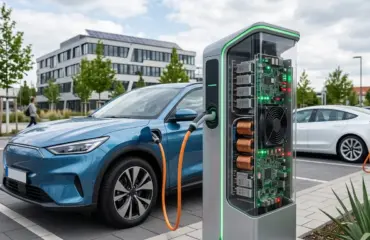
- Ultra-Fast Energy Delivery: When engineering high-power DC charging stations capable of delivering 350kW or more, the power conversion modules rely on high-dielectric semiconductors (like SiC MOSFETs) to manage massive voltage loads efficiently, ensuring rapid and safe energy transfer to the vehicle.
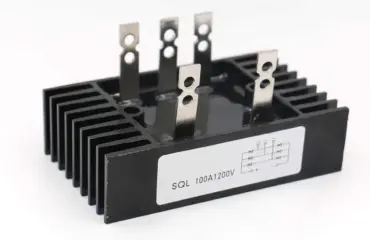
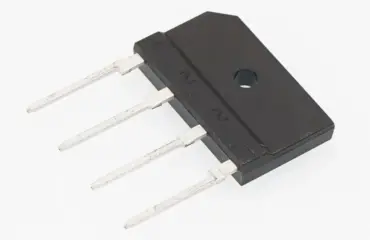
- Component Reliability at Scale: Foundational power conversion components, such as bridge rectifiers, must withstand continuous grid voltage fluctuations. High dielectric strength prevents premature breakdown, ensuring the long-term reliability required for heavy-duty commercial infrastructure.
- Smart and Safe Daily Charging: Even in lower-power applications like intelligent AC charging wallboxes, robust semiconductors guarantee the station can safely isolate high-voltage AC grid power from the user interface and low-voltage control systems, protecting both the vehicle and the consumer.