
 Deutsch
  Español
  Français
  Italiano
  Português
  Svenska
  Suomi
Suomi  Dansk
Dansk  Norsk bokmål
  Nederlands
  العربية
  עברית
עברית  Polski
  Türkçe
  Русский
  Uzbek
Uzbek  Azərbaycan
  Tiếng Việt
  ไทย
ไทย  한국어
한국어  日本語
日本語  简体中文
简体中文 
When you think of a car battery, you likely picture the 12-volt lead-acid block that starts a traditional engine and runs the headlights. In an electric vehicle (EV), however, that 12V battery is just a small supporting player. The real heavy lifting is done by a high voltage (HV) system—a sophisticated network that manages hundreds of volts to propel a multi-ton vehicle at highway speeds.
Understanding how high voltage systems work is essential for anyone entering the EV space, whether as a fleet manager, an infrastructure developer, or a curious driver. This guide breaks down the engineering behind the power and why it’s the key to the next generation of transport.
What Defines “High Voltage” in an EV?
In the automotive world, any system operating above 60V DC is generally classified as “high voltage.” While your phone uses about 5V and your home appliances use 110V or 230V, modern electric cars typically operate on architectures ranging from 400V to 800V.
These high voltages are necessary because of a simple rule of physics: to move a car, you need massive amounts of power. You can get that power by either increasing the current (amperage) or increasing the voltage. Since high current generates extreme heat and requires thick, heavy copper cables, manufacturers prefer to “up the voltage” to keep the system efficient and lightweight.
The Core Components of an EV High Voltage System
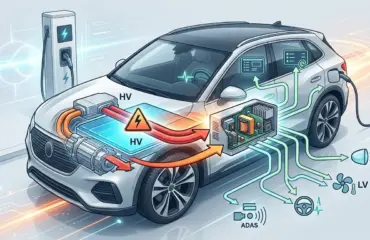
An EV’s high voltage system isn’t just one part; it’s an ecosystem of power electronics and energy storage. Each component must be precisely engineered to handle the “pressure” of high voltage.
Key High-Voltage Components
| Component | Function | Why It’s High Voltage |
|---|---|---|
| Traction Battery Pack | The “Fuel Tank” | Stores DC energy at 400V–800V to power the entire drive system. |
| Inverter | The “Brain” | Converts the battery’s DC power into AC power for the motor. |
| Electric Motor | The “Muscle” | Uses high-voltage AC to generate the torque needed to turn the wheels. |
| On-Board Charger (OBC) | The “Converter” | Converts AC from a wallbox into HV DC for the battery. |
| DC/DC Converter | The “Step-Down” | Drops high voltage (e.g., 400V) down to 12V to run the radio and lights. |
| Power Distribution Unit | The “Switchboard” | Safely routes HV power to the motor, heater, and AC compressor. |
Efficient power conversion is the backbone of these systems. This often starts at the component level with high-performance bridge rectifiers and power semiconductors that can handle rapid switching without significant energy loss.
Why High Voltage Matters: Efficiency and Speed
The shift from 400V to 800V architecture is the most significant trend in the industry today. But why does a higher number matter to the end user? It comes down to two factors: Heat and Time.
1. Reduced Heat Loss (I^2R Losses)
Electrical resistance generates heat. According to Joule’s Law, the heat produced is proportional to the square of the current (I^2). By doubling the voltage, you can halve the current while maintaining the same power output. This reduction in current results in significantly less heat, allowing for smaller cooling systems and greater overall vehicle range.
2. Radical Charging Speeds
High voltage is the “secret sauce” behind DC charging capabilities. An 800V system can theoretically charge at twice the speed of a 400V system because it can pull more power from the station without overheating the charging cable or the battery. Some 800V vehicles can now go from 10% to 80% charge in under 18 minutes.
Infrastructure: Feeding the High Voltage Beast
To support these high-voltage vehicles, the world needs a robust network of EV chargers. Depending on the use case, this infrastructure is split into two categories:
- AC Charging: Ideal for overnight or workplace stays. These AC chargers provide reliable, “slow” power that the vehicle’s On-Board Charger (OBC) converts to high-voltage DC for the battery.
- DC Fast Charging: These stations do the heavy lifting externally. They convert grid AC into high-voltage DC before it enters the car, bypassing the OBC and delivering energy directly to the battery.
Safety First: Identifying High Voltage Systems
Safety is paramount when dealing with 800V systems. Manufacturers use a universal color-coding system: Bright Orange. Any cable, conduit, or connector inside an EV that is orange is part of the high-voltage circuit. These cables are heavily shielded and equipped with interlocks that automatically shut down the power in the event of an accident or if a service panel is opened.
Pro Tip: Never touch or attempt to service orange-colored components in an EV. High-voltage systems require specialized training and insulated tools to handle safely.
The evolution of high voltage systems is what has transformed electric cars from “city commuters” into high-performance, long-distance machines. By leveraging 400V and 800V architectures, manufacturers are delivering EVs that are lighter, more efficient, and faster to charge than ever before.
As a global leader in power electronics and EV infrastructure, PandaExo provides the factory-direct hardware—from smart home wallboxes to industrial-grade rapid chargers—needed to power this high-voltage revolution.
Ready to upgrade your infrastructure? Explore our full range of professional solutions in the PandaExo Shop today.