
 Deutsch
  Español
  Français
  Italiano
  Português
  Svenska
  Suomi
Suomi  Dansk
Dansk  Norsk bokmål
  Nederlands
  العربية
  עברית
עברית  Polski
  Türkçe
  Русский
  Uzbek
Uzbek  Azərbaycan
  Tiếng Việt
  ไทย
ไทย  한국어
한국어  日本語
日本語  简体中文
简体中文 
The rapid proliferation of electric vehicles (EVs) is fundamentally reshaping the global energy and transportation landscapes. For commercial real estate developers, municipal planners, and fleet operators, investing in reliable EV infrastructure is no longer optional—it is a strategic business imperative. However, navigating the transition to electrified transport requires a precise understanding of the foundational technology powering it.
At the center of this ecosystem is the EVSE station. Often colloquially referred to as a “charging station,” EVSE—Electric Vehicle Supply Equipment—is a highly complex, intelligent energy gateway. In this comprehensive guide, we will unpack the engineering, power electronics, and smart connectivity that make modern EVSE the backbone of the e-mobility revolution.
What is EVSE? Moving Beyond the “Charger” Misnomer
The term “charger” is heavily ingrained in our everyday lexicon, but from an engineering standpoint, it is often a misnomer. For the vast majority of consumer and commercial charging applications, the actual battery charger—the component that converts alternating current (AC) from the grid into direct current (DC) for the battery—is housed inside the vehicle. This is known as the Onboard Charger (OBC).
The EVSE station, therefore, is the external equipment that acts as a secure, intelligent conduit between the electrical grid and the vehicle. Its primary functions are safety, communication, and regulated power delivery. Before a single electron flows into the vehicle’s battery, the EVSE executes a rigorous handshake protocol with the EV, verifying connection integrity, assessing battery state, and determining the maximum safe current capacity.

The Core Architectural Components of an EVSE Station
A high-performance EV charging station is a sophisticated blend of heavy-duty electrical hardware and advanced software. Whether designed for a residential garage or a sprawling commercial depot, industrial-grade EVSE units comprise several critical subsystems:
- Power Electronics & Grid Interface: This is the physical connection to the local electrical grid, equipped with extensive overcurrent protection, surge arrestors, and ground-fault circuit interrupters (GFCI).
- The Charge Controller (Control Board): The “brain” of the station. It generates a Pulse Width Modulation (PWM) signal via the Control Pilot pin to communicate with the vehicle. The duty cycle of this PWM signal dictates the exact amperage the vehicle is permitted to draw.
- Electromechanical Contactors: High-capacity relays that act as the physical gatekeepers of electricity. They remain open (de-energized) until the EVSE and the vehicle complete their safety handshake, ensuring the charging cable is entirely “dead” when not actively plugged into a vehicle.
- Smart Energy Management Module: Houses the microprocessors responsible for network connectivity (Wi-Fi, 4G/LTE, Ethernet), authorizing user access (RFID or mobile apps), and communicating with central management platforms via the Open Charge Point Protocol (OCPP).
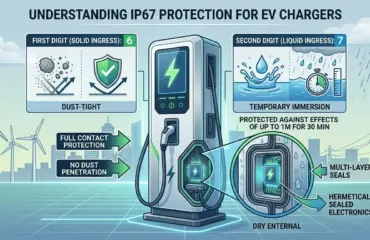
- Ruggedized Enclosure: Commercial EVSE must withstand extreme environmental conditions. High-quality stations feature IP54 to IP65 ratings for dust and water resistance, and IK08 to IK10 ratings for impact protection, ensuring continuous uptime in harsh climates.
AC vs. DC Charging: Understanding the Power Delivery Spectrum
The EVSE landscape is broadly divided into two distinct categories of power delivery, each serving different commercial use cases and requiring vastly different engineering approaches.
Level 1 & Level 2 AC Smart Charging
AC charging is the foundational layer of global EV infrastructure. In this scenario, the EVSE safely delivers alternating current to the vehicle, which is then converted to DC by the car’s onboard charger. Because they utilize the vehicle’s internal hardware for conversion, AC stations are generally more compact and highly cost-effective to deploy at scale.
Modern AC stations are no longer simple pass-through devices; they are highly connected nodes capable of dynamic load balancing and scheduled charging. For workplaces, hospitality venues, and multi-unit dwellings looking to deploy reliable charging points without triggering massive grid upgrades, exploring professional-grade AC Charging solutions is the optimal first step in infrastructure development.

Level 3 DC Fast Charging
When fleet operators and highway corridor developers require rapid energy delivery, DC Fast Charging (DCFC) is the required standard. Unlike AC systems, DC EVSE stations completely bypass the vehicle’s onboard charger. The massive power conversion (from AC grid power to DC battery power) occurs directly within the station itself.
This requires highly advanced power electronics, active liquid cooling systems, and sophisticated thermal management protocols. Delivering anywhere from 30kW to 350kW+, these stations can replenish an EV battery to 80% in under 30 minutes. For high-turnover environments where vehicle utilization rates dictate profitability, high-power DC Charging stations are the undeniable heavy lifters of the industry.

The Role of Power Electronics and Semiconductors
The efficiency, longevity, and thermal stability of an EVSE station rely entirely on the quality of its power electronics. This is particularly crucial in DC fast chargers, where massive amounts of electricity are rectified and regulated. High-frequency switching components, such as Insulated-Gate Bipolar Transistors (IGBTs) and Silicon Carbide (SiC) MOSFETs, are utilized to minimize energy loss during conversion.
At PandaExo, our deep heritage in power semiconductors directly informs our engineering architecture. By integrating highly efficient power modules and optimizing switching frequencies, we drastically reduce the heat generated during the charging process. This precise thermal management not only maximizes the amount of energy making it into the vehicle but significantly extends the operational lifespan of the station’s internal components, delivering a superior return on investment (ROI) for commercial operators.
Smart Energy Management and Connectivity
Hardware alone is no longer sufficient. Today’s EVSE stations must operate within a tightly integrated digital ecosystem. Advanced software platforms elevate a standard charger into a smart grid asset.
- Open Charge Point Protocol (OCPP): The global standard for EVSE-to-network communication. Full OCPP compliance ensures that hardware is entirely agnostic and can seamlessly integrate with any third-party billing and management software.
- Dynamic Load Management (DLM): For facilities with limited power capacity, DLM is a game-changer. It allows a network of EVSE stations to communicate with one another and intelligently distribute the available power load in real-time, preventing peak demand spikes and eliminating the need for exorbitant electrical service upgrades.
- Over-the-Air (OTA) Diagnostics: Enterprise-grade EVSE allows for remote firmware updates, proactive fault detection, and remote reboot capabilities, ensuring that maintenance teams are deployed only when absolutely necessary, thereby drastically reducing Total Cost of Ownership (TCO).
Why Scalable Manufacturing and Quality Matter
In the rapidly expanding B2B EV infrastructure market, the reliability of your supply chain is just as critical as the technology itself. Pilot projects are evolving into massive, multi-site deployments, demanding manufacturing partners capable of delivering industrial-grade hardware at immense scale.
Operating a state-of-the-art 28,000-square-meter advanced manufacturing base, PandaExo provides factory-direct scale and precision engineering. This massive operational footprint allows for rigorous end-to-end quality control and the agility to offer highly customized OEM/ODM services for enterprise clients. From bespoke software integrations to custom-branded enclosures, working directly with an elite manufacturer ensures that your deployment meets exact specifications without compromising on lead times.
Powering the Future of Mobility
Understanding the engineering and capabilities of an EVSE station is the vital first step in deploying a resilient, future-proof charging network. Whether you are aiming to electrify an urban delivery fleet or build out a nationwide network of rapid transit hubs, success hinges on selecting hardware that blends robust power electronics with intelligent software architecture.
Are you ready to elevate your facility or fleet with industry-leading technology? Explore our complete catalog of EV charging infrastructure broadly to discover how PandaExo’s smart energy solutions can drive your electrification strategy forward.