
 Deutsch
  Español
  Français
  Italiano
  Português
  Svenska
  Suomi
Suomi  Dansk
Dansk  Norsk bokmål
  Nederlands
  العربية
  עברית
עברית  Polski
  Türkçe
  Русский
  Uzbek
Uzbek  Azərbaycan
  Tiếng Việt
  ไทย
ไทย  한국어
한국어  日本語
日本語  简体中文
简体中文 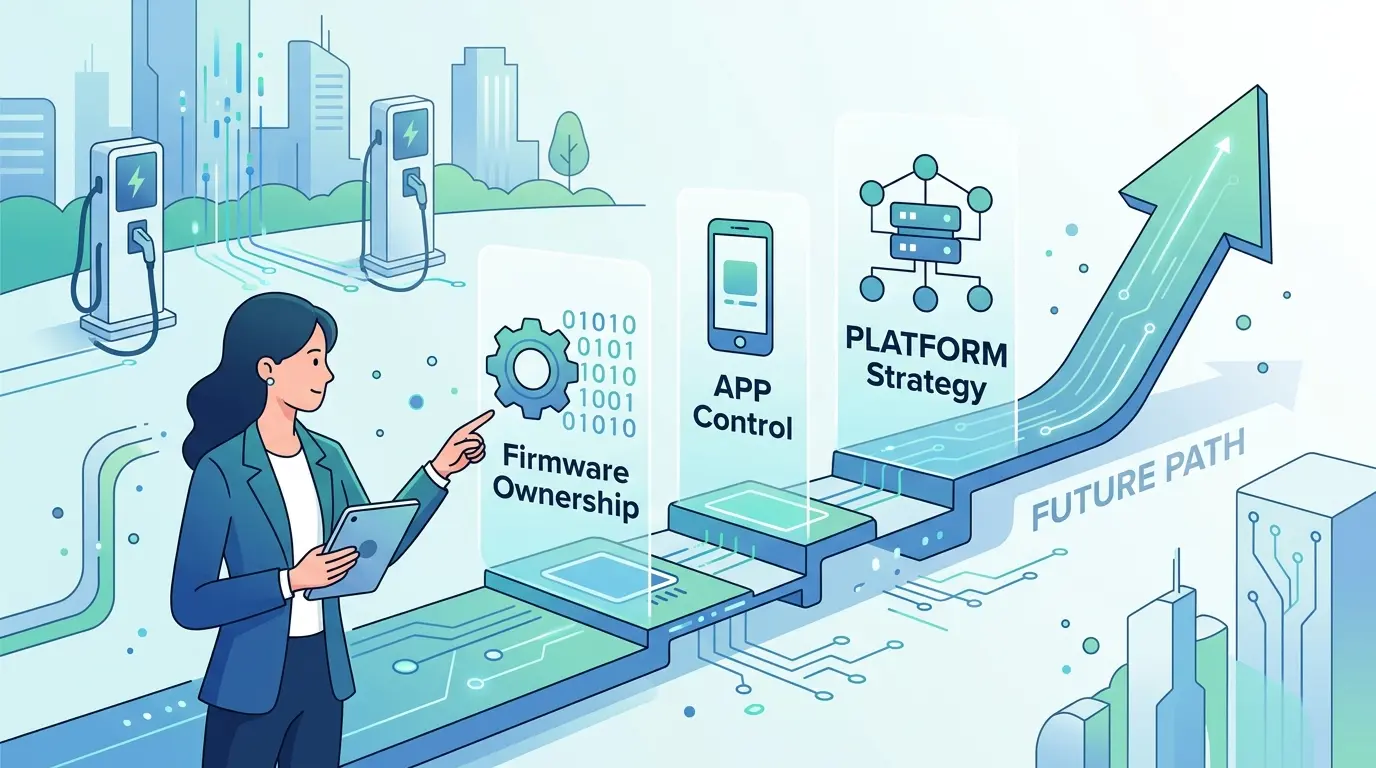
The first white-label EV charging project often looks like a hardware decision. The buyer compares enclosure design, power class, connector mix, certifications, and unit cost, then assumes the rest can be settled during implementation.
In practice, the harder risk appears after the chargers are commissioned. Who approves firmware changes when a field issue affects charging sessions? Whose app store account holds the driver relationship? Can the charger fleet stay operational if the backend platform changes two years later? For OEM buyers, those questions shape uptime, brand control, and long-term margin more than the enclosure itself.
That is why firmware, app, and platform ownership should be evaluated as an operating model decision, not as a late-stage legal detail.
The Hidden Lock-In Usually Starts in the Control Stack
OEM buyers rarely lose control at the moment the first chargers ship. They lose control later, when support tickets rise, a regional market wants localized app behavior, a fleet customer asks for deeper reporting, or a software migration becomes necessary.
The problem is that firmware, app, and backend platform are often treated as one software bundle when they do very different jobs. PandaExo’s explainer on EV charger software vs firmware is useful here because it shows why buyers need to separate in-device logic, customer-facing interfaces, and network operations before they decide what level of control they actually need.
If those layers are bundled under vague ownership language, the buyer may discover that the product is private-label only in appearance. The charger may carry the buyer’s brand while the supplier still controls release timing, user accounts, site data, and migration options.
Start by Separating the Three Ownership Layers
Before discussing contracts, OEM buyers should separate the control stack into three practical layers.
| Layer | What It Actually Controls | Main Risk If Ownership Is Vague |
|---|---|---|
| Firmware | Charging logic, diagnostics, fault handling, protocol behavior, component compatibility, update cadence | The buyer cannot manage field issues, approve changes, or protect charger behavior across markets |
| App | Driver onboarding, branding, authentication, notifications, localized UX, payment touchpoints, support entry points | The customer relationship remains tied to the supplier rather than the buyer’s brand |
| Platform | Site management, tariffs, fleet visibility, load management, APIs, reporting, user roles, remote operations | The network becomes harder to scale, integrate, or migrate later |
This separation matters because buyers do not always need the same degree of control over each layer. A company may accept supplier-managed firmware but require strong app branding and full data export rights. Another may not need to own the app, but it may need platform APIs and migration protections because its business depends on multi-site operations.
The mistake is asking only one question: who owns the software? The better question is: who controls each layer, what rights exist at each layer, and what happens if the partnership changes?
Firmware Ownership Is Really About Change Control
Firmware governs the physical behavior of the charger. It affects how the unit handles session initiation, diagnostics, fault recovery, communication with the backend, component-level compatibility, and in many cases how quickly operational issues can be corrected in the field.
That means firmware ownership is less about abstract intellectual property and more about change control. Buyers should ask who can authorize a firmware release, who validates new versions, how staged deployment works, whether rollback is possible, and how release notes are documented for channel partners and service teams.
This is also where update discipline matters. A weak update process can create more downtime than the original fault. PandaExo’s article on firmware update strategy highlights the operational value of approval workflows, controlled rollouts, and rollback planning. OEM buyers should expect those same disciplines to be spelled out before launch, not improvised after deployment.
Full firmware source-code ownership is not always necessary. Many OEM buyers do not have an embedded engineering team that wants to maintain a charger codebase directly. What matters more is whether the buyer has enough governance to protect product continuity. In many cases, a workable structure includes supplier-maintained firmware paired with clearly defined release approval rights, compatibility commitments, issue-escalation rules, and documented migration support if the backend architecture changes.
Firmware due diligence should also cover protocol roadmap questions. If an OEM buyer wants to support different regional requirements, customer billing models, or future interoperability choices, the supplier should be able to explain how firmware updates will support those changes without destabilizing deployed assets.
App Ownership Is Really About Customer Relationship Control
Many OEM buyers underestimate the app because it looks easier to replace than firmware. In reality, the app often becomes the buyer’s most visible brand layer after the charger itself.
The app controls how drivers register, how credentials are managed, how branding appears in the market, how support requests enter the system, and how users experience updates, notifications, and payment-related touchpoints. If the supplier controls the app publisher account, user identity layer, or analytics environment, the buyer may discover that the customer relationship is not truly portable.
That does not mean every OEM buyer should insist on fully owning and operating its own mobile app. For some channel models, especially where the buyer is serving fleet accounts, private depots, or semi-public workplace environments, a supplier-managed or jointly managed app can be commercially efficient. The key is to distinguish between convenience and dependency.
A buyer that accepts supplier-managed app operations should still clarify five points in writing:
- Who owns the brand presentation, naming rights, localized copy, and design approvals.
- Who controls app store publisher accounts and release publishing authority.
- Who owns user identity records, consent records, and support history.
- Which payment or billing modules can be changed without rebuilding the app strategy.
- What happens to the app and its user base if the backend supplier changes.
If those points are vague, the buyer may have a private-label app only at the surface level while the supplier retains control of the operational relationship underneath.
Platform Ownership Determines Whether the Business Can Scale
The platform is where chargers become an operating business rather than a hardware shipment. It controls site creation, tariff logic, reporting, admin roles, remote support, energy policies, firmware orchestration, and often the API layer that connects the charging network to CRM, ERP, fleet, or energy-management systems.
For OEM buyers, this is usually the most strategic ownership layer because it affects scalability. A charger program may work well for the first few sites and still become commercially fragile if the backend does not support clean data access, role separation, or multi-tenant operating models.
Interoperability should be reviewed early. PandaExo’s guide to open charging networks is relevant because open protocols and integration logic directly affect how much room the buyer has to evolve its business model later. A buyer may not need full self-hosting, but it does need confidence that the network will not become a dead end.
It is also worth being honest about tradeoffs. Fully self-hosted platform ownership sounds attractive, but many OEM buyers are not software operators. They may not want to manage cloud environments, cybersecurity workflows, platform releases, or 24/7 incident response. In those cases, a dedicated tenant with strong admin rights, API access, structured exports, and contractual migration support may be more valuable than nominal ownership with no operational capacity behind it.
The real platform question is not whether the buyer owns every backend asset. It is whether the buyer can scale, integrate, audit, and, if needed, exit without breaking the network.
What Ownership Should Mean in the Contract
In EV charging OEM agreements, ownership language is often too general to be operationally useful. Buyers should define ownership through rights, not slogans.
The contract should clarify brand rights. That includes who controls product naming, visual identity, localization, domain usage, app presentation, and customer-facing communications.
The contract should clarify release rights. That means who can approve firmware, app, and platform changes, how maintenance windows are handled, and how rollback decisions are made.
The contract should clarify data rights. Buyers should know which session data, device logs, configuration files, site records, user records, and analytics outputs can be exported, in what format, and under what timeline.
The contract should clarify integration rights. If the buyer plans to connect the platform to billing tools, fleet systems, or internal reporting workflows, API access and documentation should not be treated as optional.
The contract should clarify exit rights. A formal EV charger data handover checklist is one of the clearest ways to test whether ownership will still mean something when the relationship changes.
Migration support belongs in the same discussion. Buyers should not wait until a contract renewal problem appears before asking how chargers would move to another operating environment. PandaExo’s article on network migration best practices reflects the right mindset: migration risk should be evaluated before the first large rollout, not after a platform becomes deeply embedded.
A Practical Evaluation Scorecard for OEM Buyers
The most useful procurement conversations move from broad claims to testable questions.
| Evaluation Question | Why It Matters | Stronger Answer Looks Like |
|---|---|---|
| Who approves firmware releases and emergency patches? | Protects charger behavior in the field | Approval workflow, release notes, rollback rules, and escalation structure are clearly defined |
| Can the buyer brand and control the app experience? | Protects market positioning and user trust | Branding rights, localization control, and publishing authority are documented |
| Who owns user accounts, session history, and site data? | Prevents customer and operational lock-in | Export scope, format, retention, and transfer obligations are explicit |
| Can the platform support APIs and future integrations? | Supports billing, fleet, and enterprise workflows | API availability, documentation, and access rules are part of the commercial scope |
| What happens if the backend platform changes? | Tests real portability | Charger continuity, data handover, and migration support are addressed contractually |
| Does the supplier support staged governance, not just access credentials? | Access alone does not equal control | Roles, approvals, maintenance windows, and auditability are built into the operating model |
| Which layer is supplier-managed versus buyer-managed? | Prevents responsibility gaps | Firmware, app, and platform responsibilities are separated clearly |
| Is the chosen ownership model aligned with the buyer’s actual operating capacity? | Avoids buying theoretical control that cannot be used | The governance model matches the buyer’s team, market strategy, and support resources |
This scorecard usually leads to a more productive outcome than asking for blanket ownership of everything. In many OEM programs, the best structure is layered control: strong governance where the buyer needs strategic control, supplier responsibility where specialized technical maintenance is still more efficient, and clear migration protections across both.
Different OEM Models Need Different Ownership Profiles
Not every OEM buyer should pursue the same stack design.
A brand-led regional charger company may prioritize app control, localized UX, market-specific workflows, and clear platform APIs because its differentiation depends on brand experience and service design.
A fleet-oriented solution provider may care less about consumer app presentation and more about backend visibility, role permissions, issue escalation, and integration with dispatch or energy workflows.
A distributor with limited software resources may reasonably prefer supplier-managed firmware and platform operations, provided branding, data access, and exit rights are strong enough to protect future optionality.
That is why procurement teams should resist absolute language. Full ownership is not automatically the best answer. Operationally usable control is the better goal.
Practical Summary
OEM buyers should evaluate firmware, app, and platform ownership with the same rigor they apply to charger power levels, site design, and procurement cost. In EV charging, control over updates, branding, data, and migration often determines long-term business value more than the first hardware shipment.
The strongest ownership structure is usually the one that answers four practical needs clearly: firmware governance that protects charger performance, app control that protects the customer relationship, platform rights that protect scale and integration, and exit provisions that protect future flexibility.
For PandaExo OEM and ODM discussions, that means looking beyond hardware customization alone. Buyers should ask whether charger engineering, smart platform support, and brand requirements can be aligned inside a governance model that remains workable after rollout, during growth, and if the partnership needs to evolve.