
 Deutsch
  Español
  Français
  Italiano
  Português
  Svenska
  Suomi
Suomi  Dansk
Dansk  Norsk bokmål
  Nederlands
  العربية
  עברית
עברית  Polski
  Türkçe
  Русский
  Uzbek
Uzbek  Azərbaycan
  Tiếng Việt
  ไทย
ไทย  한국어
한국어  日本語
日本語  简体中文
简体中文 
As electric vehicle (EV) adoption accelerates globally, the home garage has transformed into the primary refueling station for millions of drivers. However, optimizing your home charging infrastructure goes far beyond simply plugging into a standard wall outlet. Achieving peak efficiency, safety, and charging speed requires selecting the exact right hardware—starting with your EV charging cable.
For both residential users looking for reliability and B2B developers equipping modern smart homes, understanding the technical nuances of EV cables is critical. At PandaExo, we leverage our 28,000-square-meter advanced manufacturing base and deep heritage in power semiconductors to engineer world-class charging solutions.
Here is our expert guide on how to choose the right EV charging cable for your home setup, ensuring safe, rapid, and future-proof power delivery.
1. Tethered vs. Untethered Cables: Which is Right for You?
Before looking at technical specifications, the first architectural decision for your home charging station is whether to use a tethered or untethered setup.
- Tethered Cables: These cables are permanently attached to the wallbox. They offer maximum convenience, as you simply park, grab the cable, and plug it in. However, you are locked into a specific connector type and cable length.
- Untethered (Socketed) Cables: The wallbox features a socket, and you must supply your own separate cable. While slightly less convenient, this setup offers excellent flexibility. It allows you to easily replace a damaged cable, upgrade to a longer one, or accommodate visiting EVs with different plug standards.
2. Match the Connector to Your EV
The connector type is the most critical factor in your selection process. Home charging infrastructure relies almost exclusively on alternating current (AC), which dictates the type of plug you will need.
- Type 1 (J1772): Predominantly found in North America and on older Asian EV models, this is a single-phase plug capable of delivering up to 7.4 kW of power.
- Type 2 (Mennekes): The standard across Europe and widely adopted globally. The Type 2 connector supports both single-phase and three-phase power, allowing for significantly higher AC charging speeds (up to 22 kW).
- NACS (North American Charging Standard): Rapidly becoming the new standard in North America, championed by Tesla and now adopted by most major automakers.
When upgrading your home infrastructure, selecting high-quality AC charging solutions guarantees stable, intelligent energy management tailored to these standard connectors.
3. Power Ratings: Single-Phase vs. Three-Phase
The charging speed of your cable must align with your home’s electrical supply, your wallbox output, and your vehicle’s onboard charger capacity.
- 16 Amp (3.6 kW): Generally suited for plug-in hybrid electric vehicles (PHEVs) or smaller EVs. It provides roughly 10–15 miles of range per hour of charging.
- 32 Amp (7.4 kW): The gold standard for modern single-phase home charging. A 32A cable can deliver up to 25–30 miles of range per hour, easily recharging a standard EV overnight.
- Three-Phase (11 kW to 22 kW): If your property has a three-phase power supply, a compatible Type 2 cable can drastically reduce charging times. Ensure your vehicle’s onboard inverter can accept these higher AC loads.
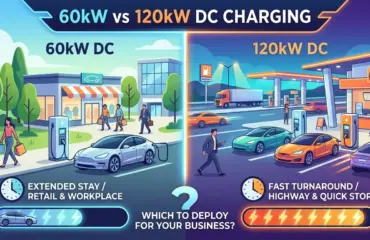
While homes utilize AC power, commercial fleets and public highway stations rely on high-power DC fast charging infrastructure to bypass the vehicle’s onboard converter for rapid, direct-to-battery energy delivery.
4. Cable Length and Durability
A common mistake is underestimating the required cable length. When selecting a cable, consider:
- Optimal Length: A 5-meter (16-foot) cable is standard and sufficient for most driveways. However, if you have a multi-car garage or park awkwardly, investing in a 7-meter or 10-meter cable prevents hazardous stretching and strain on the connectors.
- Build Quality & Weather Resistance: An EV cable must endure extreme temperatures, UV exposure, and physical wear. Look for cables with IP54 or IP55 ratings to ensure resistance to dust and water ingress.
- Internal Components: Superior cables and the wallboxes they connect to rely on factory-direct precision. The longevity of your charging ecosystem is dictated by its power electronics. High-performance setups utilize industrial-grade semiconductor components—such as a robust bridge rectifier for flawless power conversion—ensuring stable energy flow without dangerous voltage spikes.
5. Future-Proofing Your Home Charging Ecosystem
The EV market is evolving rapidly. When investing in home charging hardware, it pays to think ahead. Even if your current EV only accepts 3.6 kW, purchasing a 32A (7.4 kW) or three-phase capable cable ensures you won’t need to replace your equipment when you upgrade your vehicle.
Furthermore, integrating your cable with a smart energy management platform allows you to monitor usage, schedule charging during off-peak utility rates, and balance power loads across your household.
Upgrade Your EV Infrastructure with PandaExo
Choosing the right EV charging cable is just one piece of the puzzle. To truly optimize your home energy ecosystem, you need reliable, factory-direct hardware engineered for scale and precision.
Whether you are a homeowner seeking a dependable smart wallbox or a developer sourcing infrastructure for residential projects, PandaExo delivers unmatched OEM/ODM capabilities and technological excellence.
Ready to build a smarter, faster charging setup? Explore our comprehensive EV charger catalog to find the perfect fit for your power needs, or browse our full range of solutions directly at the PandaExo shop.