
 Deutsch
  Español
  Français
  Italiano
  Português
  Svenska
  Suomi
Suomi  Dansk
Dansk  Norsk bokmål
  Nederlands
  العربية
  עברית
עברית  Polski
  Türkçe
  Русский
  Uzbek
Uzbek  Azərbaycan
  Tiếng Việt
  ไทย
ไทย  한국어
한국어  日本語
日本語  简体中文
简体中文 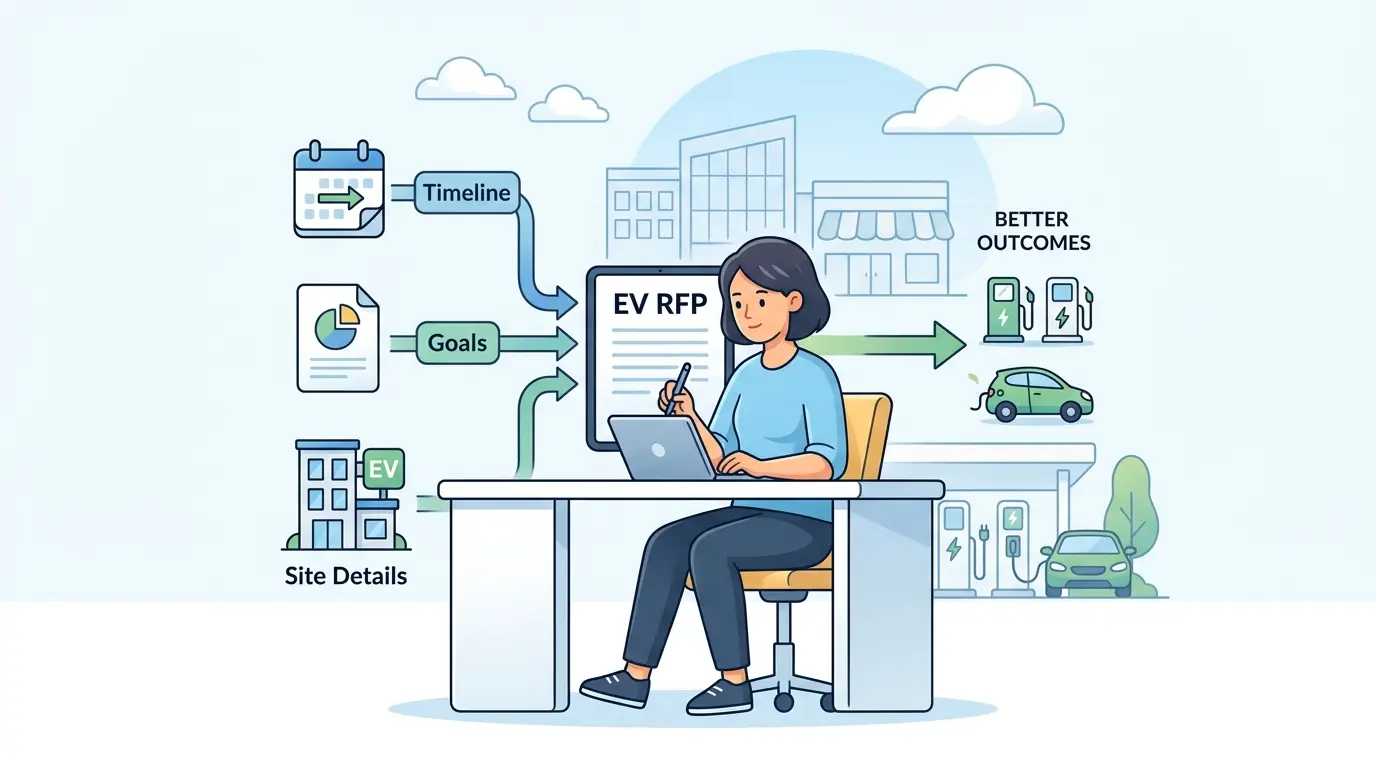
Many commercial EV charging projects go off track before vendors even respond. The problem is usually not a lack of interest from suppliers. It is that the RFP asks for charger pricing before it defines the operational reality that the charging system needs to support.
An RFP that says “quote ten chargers” may feel efficient, but it often hides the decisions that actually shape project success: who will use the site, how long vehicles dwell, what utility limits exist, how future expansion should work, and what software visibility the operator will need once the equipment is live. When those points stay vague, vendors either price against assumptions that do not match the site or respond so broadly that proposals become hard to compare.
For infrastructure buyers, project developers, fleet operators, distributors, and site hosts, a better RFP does not just request hardware. It frames the business case, the site constraints, and the performance expectations clearly enough that vendors can propose a workable charging plan instead of a generic equipment list.
Why Many EV Charging RFPs Produce Weak Vendor Responses
Most weak RFPs fail in one of two ways. They are either too thin, with only a charger count and a target power level, or too prescriptive, with the buyer trying to lock every technical detail before the site has been properly validated.
Both approaches create risk. A thin RFP forces vendors to guess. An overly rigid RFP prevents suppliers from pointing out better-fit alternatives around charger mix, site phasing, software architecture, or load management.
That is why the strongest RFPs sit in the middle. They are specific about business outcomes, site realities, and evaluation criteria, but they still leave room for the vendor to show how the project should be configured. If the early project questions are not yet settled, it is often worth reviewing a practical commercial EV charging project checklist before issuing the RFP at all.
Define the Project Outcome Before You Describe the Hardware
Before writing technical requirements, state what the charging project is meant to achieve.
That sounds obvious, but many RFPs skip it. The buyer may know the site wants EV charging, yet the vendor still does not know whether the main goal is tenant amenity, employee retention, retail dwell capture, fleet readiness, public charging revenue, ESG reporting, or phased portfolio expansion. Those goals lead to different charger choices, software priorities, and support models.
At minimum, the RFP should explain:
- Who the primary users are
- Whether charging is public, private, fleet-only, or mixed access
- What dwell times are expected
- Whether revenue generation matters
- Whether the project is a pilot, a first build phase, or part of a larger rollout
- What success looks like in the first 12 to 24 months
When the business objective is clear, vendors can design around throughput, reliability, access control, and scalability instead of simply maximizing headline power.
Separate Non-Negotiable Requirements From Buyer Preferences
One of the easiest ways to improve proposal quality is to distinguish must-have requirements from preferred options.
If everything is written as mandatory, the RFP becomes harder to answer honestly. Vendors may either overcomply with unnecessary cost or understate where tradeoffs exist. If everything is written as optional, the buyer loses control over critical project needs.
Use three categories:
- Mandatory requirements: conditions the project truly cannot proceed without
- Preferred requirements: features or design choices that improve fit but are not absolute
- Vendor recommendations: areas where the supplier is invited to propose alternatives
This structure is especially useful for issues like charger form factor, cable management approach, payment workflow, branding, load balancing strategy, and phased deployment logic. It also helps buyers compare suppliers more fairly, because the difference between a compliance gap and a design preference stays visible.
Describe the Site Conditions Vendors Actually Need to Price Correctly
If the site reality is thin, pricing will be thin too.
Commercial EV charging proposals are shaped by far more than the charger itself. Civil works, switchgear position, trench distance, parking layout, transformer proximity, communication method, and future conduit planning can move project cost and schedule significantly. A good RFP gives vendors enough site context to price responsibly.
Useful inputs include:
- Site address and site type
- Number and type of parking bays in scope
- Available utility information and service capacity if known
- Preliminary site plans, photos, or one-line diagrams if available
- Expected hours of operation and access rules
- Vehicle mix and expected charging behavior
- Whether future expansion is likely in the same car park or adjacent areas
Site demand assumptions matter just as much as electrical inputs. If the project team is still working out likely user behavior, PandaExo’s EV charging site selection guide is helpful because it frames charging demand around real property and fleet conditions rather than around abstract charger counts.
Ask Vendors to Solve the Utility and Infrastructure Problem, Not Ignore It
Some RFPs treat utility readiness as if it will be resolved later. That is a mistake.
Commercial charging projects are often delayed not by charger manufacturing lead times, but by upstream electrical work, utility coordination, make-ready scope, transformer timing, approvals, or demand-charge exposure. If the RFP does not ask vendors how they expect the site to interact with those constraints, it becomes harder to compare real project readiness.
The RFP should ask vendors to comment on:
- Likely utility dependency and make-ready assumptions
- Whether phased energization is recommended
- How charger power should be matched to available capacity
- Whether load management could reduce required upgrades
- What buyer-side information is still missing before final engineering
That does not mean the vendor must own every utility conversation. It means the buyer wants to see whether the supplier understands how utilities evaluate commercial charging projects. This is often where project realism improves fastest, and PandaExo’s guide on make-ready, transformers, and approval timelines is aligned with that same planning logic.
Build the RFP Around Charging Strategy, Not Just Charger Quantity
An RFP should not force all vendors toward the same charger mix before the operating case is clear.
For example, a workplace site with long dwell times may be better served by a higher count of AC smart chargers rather than a small number of oversized DC units. A fleet or high-turnover commercial site may need selective DC fast charging to protect turnaround and throughput. A mixed-use location may need both, but in different phases.
That is why the RFP should ask vendors to explain the charging logic behind their proposal. The buyer is not only purchasing equipment. The buyer is selecting a site strategy.
| RFP Topic | What Vendors Should Provide | Why It Matters |
|---|---|---|
| Charger mix | AC, DC, or mixed recommendation with reasoning | Prevents overbuying power or under-serving demand |
| Power level logic | Why each charger class fits dwell time and site turnover | Links hardware to actual usage patterns |
| Phasing plan | What should be installed now versus prepared for later | Reduces overspending while protecting expansion |
| Electrical strategy | Load management, diversity assumptions, and upgrade implications | Improves site fit and lowers infrastructure risk |
| Operational workflow | Access control, payment, monitoring, and maintenance model | Shows whether the site will be manageable after go-live |
If the buyer wants a broader reference point before locking the specification, reviewing the wider EV charger product landscape can help frame which charger classes and deployment types belong in scope.
Make Software, Data, and Interoperability Explicit in the RFP
Many RFPs still treat software as an add-on line item. In practice, software is part of the operating system of the charging site.
If the project includes public access, portfolio reporting, fleet prioritization, RFID or app authentication, payment handling, dynamic load management, or remote fault visibility, the RFP should ask vendors to explain their software model clearly. Buyers should not assume that “networked charger” means the same thing across vendors.
The RFP should ask for clear responses on:
- Dashboard visibility and reporting fields
- User authentication methods
- Payment and billing capabilities if needed
- Load balancing and power management logic
- Alarm handling and remote diagnostics
- Data ownership and export rights
- OCPP or other interoperability support where relevant
This is especially important for buyers who want optionality over the life of the site. A project that seems cheaper at procurement can become more restrictive later if data export, platform migration, or third-party interoperability were never defined. PandaExo’s explainer on open charging networks and interoperability trends is useful context because it shows why software openness is not only a technical preference but an operating risk decision.
Require a Delivery, Commissioning, and Support Plan
The charging project does not end when the chargers arrive on site. A better RFP asks how the vendor will help the project move from procurement to reliable operation.
That means requesting more than equipment lead times. Buyers should also ask for the commissioning process, site acceptance workflow, training approach, warranty structure, spare parts logic, and support escalation model.
Good questions include:
- What information is needed before the vendor can finalize the design?
- What is the commissioning sequence and who signs off each stage?
- What testing is performed before handover?
- What operator training is included?
- How are critical faults escalated after launch?
- What remote monitoring is available?
- What documentation is delivered at handover?
For larger projects, buyers should also ask how the vendor supports future site expansion, additional chargers, or platform updates. The best commercial charging suppliers are easier to work with not only because they ship hardware, but because they reduce uncertainty during buildout and early operations.
Avoid the Most Common RFP Mistakes
Several mistakes appear again and again in commercial EV charging procurement.
The first is using charger count as the main basis for comparison. Two vendors can quote the same number of chargers while assuming very different electrical scope, software capability, and support depth.
The second is failing to define how proposals will be scored. If vendors do not know whether the buyer values lowest upfront cost, lowest infrastructure disruption, strongest scalability, best software visibility, or fastest deployment, responses will be uneven and difficult to evaluate.
The third is ignoring future growth. A site may only need a limited number of active charging points today, but it may still make sense to ask vendors how conduit preparation, switchgear planning, or software architecture would support future expansion.
The fourth is asking for brand-specific hardware without explaining the business reason. If a specification is too narrow too early, the buyer may lose the benefit of vendor engineering input.
A Practical Structure for a Stronger EV Charging RFP
The best RFPs are usually easier to read than the weak ones. They are structured, direct, and honest about what is known and what still needs supplier input.
A practical format looks like this:
- Project overview: site type, business goal, and deployment timeline.
- User profile: who will charge, when, and under what access rules.
- Site information: drawings, electrical context, parking layout, and communications assumptions.
- Required outcomes: throughput, visibility, payment, fleet rules, uptime expectations, or expansion needs.
- Vendor response requirements: charger strategy, site design assumptions, power management approach, software scope, delivery model, and support plan.
- Commercial response requirements: equipment pricing, installation assumptions, excluded scope, warranty terms, and ongoing service options.
- Evaluation criteria: how the buyer will compare proposals.
That last section matters more than many teams expect. When suppliers understand the scoring model, they are more likely to answer the RFP in a way that is useful rather than performative.
Practical Summary
A better RFP for a commercial EV charging project does not try to pre-design the entire site, and it does not reduce the project to charger pricing alone. It explains the operating reality, clarifies what matters most, documents the site constraints, and asks vendors to respond with a workable charging strategy.
That approach produces better proposals because suppliers can respond to real project conditions instead of guessing around them. It also gives buyers a stronger basis for comparison across charger mix, utility fit, software readiness, delivery discipline, and long-term scalability.
In practical terms, the strongest RFP is the one that helps the buyer compare vendors on project fit, not just on hardware line items. For commercial EV charging, that is usually the difference between a proposal that looks competitive and a project that actually works once the site goes live.