
 Deutsch
  Español
  Français
  Italiano
  Português
  Svenska
  Suomi
Suomi  Dansk
Dansk  Norsk bokmål
  Nederlands
  العربية
  עברית
עברית  Polski
  Türkçe
  Русский
  Uzbek
Uzbek  Azərbaycan
  Tiếng Việt
  ไทย
ไทย  한국어
한국어  日本語
日本語  简体中文
简体中文 
As EV charging power levels increase, thermal performance becomes one of the clearest limits on long-term hardware reliability. In high-power onboard chargers, the front-end rectification stage must process substantial current while remaining inside safe operating temperatures. That is why thermal management around GBJ series flat bridge rectifiers is not a secondary design detail. It is a core engineering decision.
For OEM teams, charger designers, and semiconductor buyers, the practical question is straightforward: can the rectifier package move heat out fast enough to support repeated charging cycles without degrading system efficiency or shortening component life? This article explains why GBJ packages are widely used in higher-power OBCs, where the heat comes from, and what engineering strategies matter most.
Why GBJ Series Flat Bridges Are Used in High-Power OBCs
An onboard charger converts incoming AC into DC for the vehicle battery. The bridge rectifier sits at the front of that conversion chain, making it one of the first components exposed to input current, conduction loss, and thermal stress.
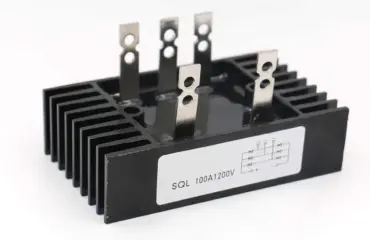
GBJ packages are popular in this role because their flat mechanical profile supports direct heatsink mounting. That packaging advantage matters in real designs because the thermal path often determines whether the rectifier remains reliable under sustained charging load.
The package is valued not only for electrical handling, but for how it fits into practical cooling architecture.
| GBJ Package Characteristic | Why It Matters in OBC Design | Operational Benefit |
|---|---|---|
| Flat, low-profile housing | Supports close mechanical integration in compact charger layouts | Helps designers package higher-power OBCs more efficiently |
| Direct heatsink mounting | Creates a shorter and more effective thermal path | Reduces junction temperature rise during charging |
| Suitability for medium-to-high current applications | Matches the demands of modern OBC power stages | Supports more robust power conversion under real vehicle use |
| Familiar bridge-rectifier format | Simplifies integration into established AC-to-DC topologies | Improves design repeatability and sourcing flexibility |
For teams working across charging architectures, PandaExo’s article on the role of the onboard charger in AC-to-DC conversion is a useful companion reference.
Where the Thermal Problem Starts
Rectifiers generate heat because conduction through the diode path is never lossless. In an onboard charger, that heat rises quickly as charging power and input current increase. At 3.3kW, the thermal burden may still be manageable with conservative design margins. At 11kW and 22kW, the cooling strategy becomes much more critical.
The main issue is not that heat exists. The issue is whether the full thermal path can move that heat away from the silicon fast enough.
The thermal chain usually includes:
- Junction-to-case heat transfer inside the rectifier package
- Case-to-heatsink transfer across the mounting interface
- Heatsink-to-ambient or heatsink-to-coolant transfer through the wider system
If any one of those links is weak, the entire thermal design suffers.
What Happens When Thermal Dissipation Is Inadequate
Poor thermal management in a high-power OBC rarely stays isolated to the rectifier alone. It usually affects the efficiency, service life, and stability of the broader charger assembly.
| Thermal Issue | What It Does to the Rectifier | What It Can Mean for the OBC |
|---|---|---|
| High junction temperature | Accelerates electrical stress and material wear | Lower long-term reliability and greater failure risk |
| Poor interface contact | Traps heat at the case-to-sink boundary | Higher operating temperature under the same current load |
| Inadequate heatsink design | Limits the ability to reject heat continuously | Performance drift or thermal derating during charging |
| Localized PCB hot spots | Adds secondary heating around the package leads | More stress on nearby components and solder joints |
| Weak system cooling | Allows temperature rise across the entire power stage | Reduced charger efficiency and shorter lifecycle performance |
In commercial terms, this means more warranty exposure, more troubleshooting time, and lower confidence in sustained charging performance.
Strategy 1: Improve the Heatsink Interface
The first thermal decision is mechanical, not digital. A GBJ package only delivers its thermal advantage if the path into the heatsink is well executed.
That typically means focusing on:
- Flat and consistent mounting surfaces
- Appropriate clamping or screw torque
- Thermal interface materials that reduce air gaps
- Interface materials matched to insulation and conductivity requirements
Even high-quality rectifiers can run hotter than expected if the contact area is poor or if mounting pressure is inconsistent. In practice, many thermal failures blamed on the semiconductor are actually interface failures.
Strategy 2: Use the PCB as a Secondary Heat-Spreading Asset
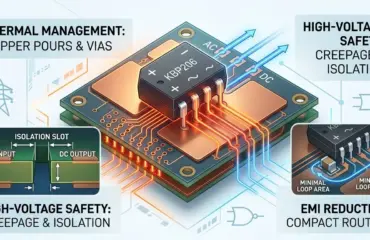
The heatsink is usually the main cooling path, but the PCB still matters. Heat also moves through the component leads into the board, which means layout decisions influence local temperature behavior.
Useful PCB-side practices often include:
- Heavier copper layers for better spreading
- Better distribution of current paths around the rectifier
- Thermal vias near mounting and high-heat regions
- Layout that avoids stacking additional thermal stress around the same area
This does not replace heatsink design. It complements it by reducing local concentration of heat and improving overall thermal balance across the power stage.
Strategy 3: Match Cooling Method to Charger Power Level
Not every OBC requires the same cooling approach. Lower-power systems may perform well with carefully designed passive or assisted cooling. Higher-power systems, especially in tightly packaged automotive environments, often need more advanced thermal integration.
The cooling choice should follow the actual operating profile of the charger.
| Cooling Approach | Typical Fit | Design Tradeoff |
|---|---|---|
| Passive heatsink only | Lower-power or less space-constrained systems | Simpler design, but limited headroom as power rises |
| Heatsink with forced air | Systems where airflow is possible and packaging permits it | Better heat rejection, but depends on fan reliability and contamination control |
| Liquid-cooled thermal path | Higher-power sealed automotive systems | Strong thermal performance, but greater integration complexity |
For modern higher-power OBCs, liquid-cooled or tightly integrated thermal blocks are often preferred because packaging, ingress protection, and charging power targets leave less margin for conventional airflow-based cooling.
Strategy 4: Treat Thermal Design as a Reliability Decision, Not a Compliance Check
Thermal design is sometimes handled like a final validation step. That is usually too late. In high-power rectifier applications, thermal choices should be made early because they influence package selection, mechanical layout, enclosure design, and lifecycle cost.
This is where material quality and semiconductor consistency begin to matter. A design with narrow thermal margin is much less tolerant of manufacturing variation, interface inconsistency, or field aging.
PandaExo’s article on why thermal management is the core of EV power module reliability expands on that broader reliability view.
How GBJ Packages Compare With Alternative Rectifier Formats
GBJ is not the only package used in rectification, but it occupies an important middle ground for applications that need meaningful current handling with practical heatsink integration.
| Package Type | Typical Strength | Common Limitation | Best-Fit Context |
|---|---|---|---|
| GBJ | Good thermal path with flat heatsink mounting | Usually depends on dedicated thermal design to perform well | Medium-to-high power OBCs, EVSE, industrial conversion stages |
| GBU | Simpler option for lower thermal demand | Less favorable for more demanding heat loads | Lower-power onboard charging and lighter-duty applications |
| Discrete surface-mount solutions | Very flexible for customized layouts | Higher design complexity and stronger PCB thermal dependency | Custom power stages with specialized integration goals |
The right package choice depends on more than current rating. Mechanical integration, cooling architecture, and production consistency all affect which option makes the most sense.
Why PandaExo’s Semiconductor Experience Is Relevant
In thermal management, packaging quality and semiconductor quality work together. PandaExo’s relevance here comes from the fact that it combines EV charging infrastructure knowledge with deep experience in power semiconductors and factory-scale manufacturing.
That matters for buyers because it helps connect component-level decisions with system-level outcomes such as:
- More dependable heat handling under sustained charging conditions
- Better manufacturing consistency across production volume
- Stronger fit for OEM and ODM charger development
- More confidence that thermal design decisions align with real charging use cases
For companies building durable charging hardware or evaluating component supply for future programs, that combination is commercially meaningful. PandaExo’s broader EV charging solutions portfolio reflects that link between semiconductor performance and infrastructure reliability.
What Buyers and Designers Should Review Before Finalizing a GBJ-Based Design
Before approving a rectifier selection for a high-power OBC, technical teams should review the thermal system as a whole rather than evaluating the package in isolation.
Key review points include:
- Whether the mounting interface is optimized for repeatable heat transfer.
- Whether the heatsink has enough real thermal headroom for sustained operation.
- Whether PCB spreading has been designed to reduce local hot spots.
- Whether the cooling architecture matches the intended power level and enclosure constraints.
- Whether the chosen component supplier can deliver consistent semiconductor quality at scale.
This is the difference between a design that passes a test bench and one that remains dependable in real vehicles over time.
Final Takeaway
Managing thermal dissipation in GBJ series flat bridges is not just about keeping one package cool. It is about protecting the full onboard charger from avoidable losses, premature aging, and reliability problems as charging power rises.
GBJ packages remain attractive because they combine practical integration with meaningful thermal potential, but they only perform well when the full thermal path is engineered correctly. If you are evaluating rectifier solutions or charging hardware with stronger thermal foundations, contact the PandaExo team to discuss components and infrastructure designed for long-term power-electronics reliability.