
 Deutsch
  Español
  Français
  Italiano
  Português
  Svenska
  Suomi
Suomi  Dansk
Dansk  Norsk bokmål
  Nederlands
  العربية
  עברית
עברית  Polski
  Türkçe
  Русский
  Uzbek
Uzbek  Azərbaycan
  Tiếng Việt
  ไทย
ไทย  한국어
한국어  日本語
日本語  简体中文
简体中文 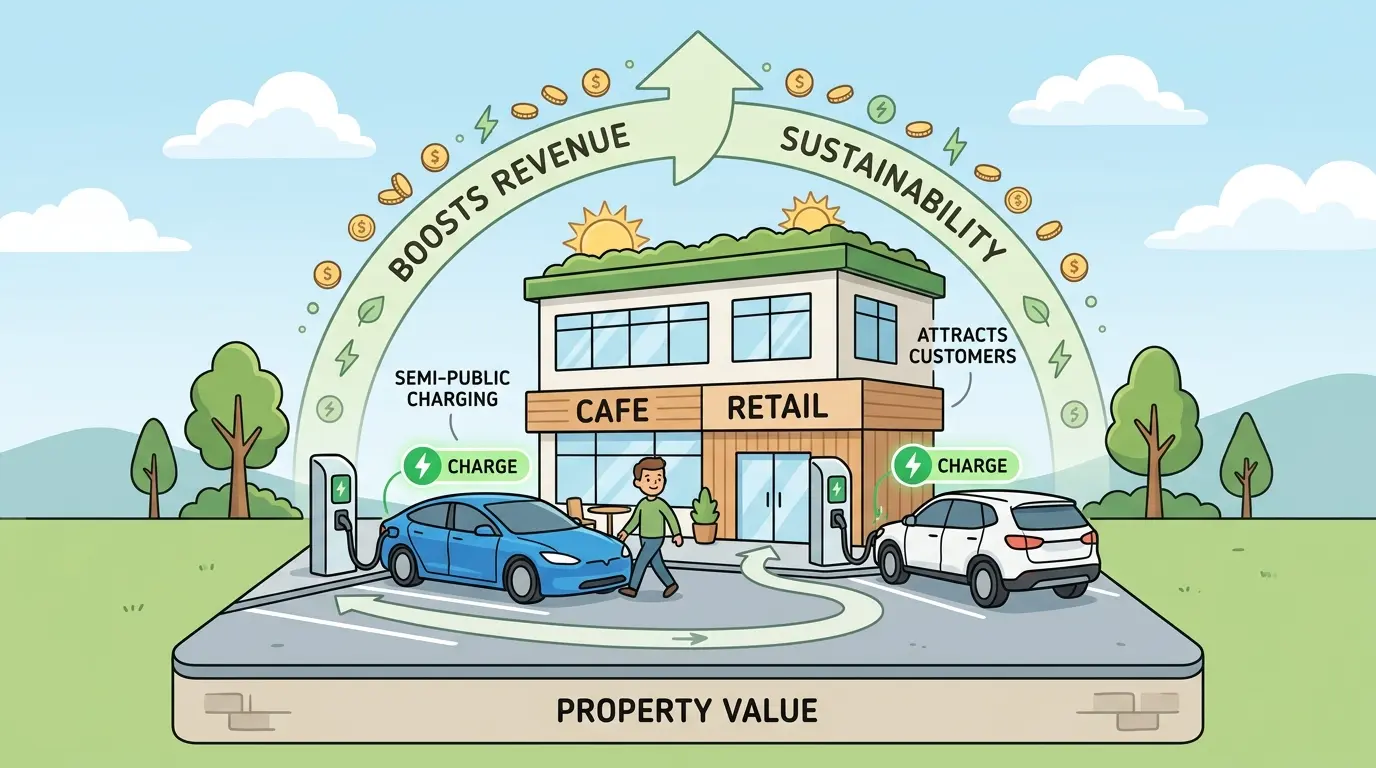
The biggest financial mistake in semi-public EV charging is assuming the business case lives or dies on charger revenue alone.
For office parks, hotels, retail centers, business campuses, and mixed-use commercial properties, the real economics are broader. Charger selection affects capital cost, utility exposure, parking turnover, tenant experience, site attractiveness, and future expansion risk. A charger that looks affordable on a product sheet can become expensive once electrical upgrades, billing software, access control, maintenance, and low utilization are accounted for. At the same time, a site that appears only modestly profitable on direct charging revenue may still be a strong investment if it improves occupancy, tenant retention, or customer dwell time.
That is why semi-public charging should be evaluated as a property operations decision, not just an equipment purchase.
What Semi-Public Charging Actually Means for a Commercial Site
Semi-public charging sits between fully private charging and open public charging. The chargers are usually located on private commercial property, but they are available to a controlled group such as tenants, employees, hotel guests, visitors, shoppers, or approved fleet users.
That distinction matters because the economics are different from a highway fast-charging site. Semi-public charging usually benefits from more predictable dwell times, clearer user profiles, and site-level control over parking rules and pricing. It also tends to face lower throughput pressure than a pure public charging hub.
| Site Context | Typical Users | Dwell Pattern | Main Economic Priority |
|---|---|---|---|
| Office or business campus | Employees, tenants, visitors | Multi-hour daytime parking | Amenity value, controlled access, manageable operating cost |
| Hotel or serviced property | Guests, occasional visitors | Overnight or extended dwell | Guest experience, property differentiation, moderate monetization |
| Retail with longer visits | Shoppers, staff, nearby users | Medium dwell with peaks | Parking turnover, convenience, selective revenue capture |
| Mixed-use commercial property | Tenants, visitors, service vehicles | Variable by daypart | Flexibility, access control, phased scalability |
When buyers miss this distinction, they often benchmark against the wrong model and over-invest in power level, connector count, or open-access complexity that the property does not actually need.
The Cost Stack Is Broader Than the Charger Itself
The charger is only one layer of the investment. In many semi-public projects, the real financial outcome is shaped more by site work and ongoing operating structure than by the hardware invoice.
| Cost Layer | What It Includes | Why It Changes The Economics |
|---|---|---|
| Make-ready and civil work | Trenching, conduit, bollards, pads, signage, parking modifications | Often determines whether expansion later will be cheap or disruptive |
| Electrical infrastructure | Panels, switchgear, transformer work, cabling, utility coordination | Can make higher-power charging disproportionately expensive |
| Charging hardware | AC or DC units, pedestals, cable management, enclosures | Must match dwell time and use case, not just headline power |
| Software and billing | User authentication, pricing logic, payment processing, reporting, remote management | Converts a charger from a static asset into an operating system |
| Ongoing operations | Maintenance, inspections, firmware updates, support, cleaning, parking enforcement | Lowers or improves lifetime value depending on execution discipline |
This is also why utility coordination has to be modeled early. The economics can shift materially once demand charges, interconnection timing, or service upgrades enter the picture. PandaExo’s guidance on grid capacity, interconnection, and demand charges is useful here because many commercial site hosts underestimate how strongly upstream electrical constraints shape total project cost.
In practice, the most resilient projects are rarely the ones with the highest power. They are the ones where the electrical backbone, charger class, and access model are aligned from the start.
Utilization Usually Matters More Than Nameplate Power
Semi-public charging economics are driven by utilization quality, not just charger capability. A lightly used fast charger can be a weaker investment than a well-used AC charger serving predictable daily demand.
That is especially true at properties where vehicles remain parked for hours. Offices, hotels, and many commercial destinations often have enough dwell time for managed AC charging to do the job without the added infrastructure burden of high-power DC.
| Question | If The Answer Is Mostly Yes | Likely Better Fit |
|---|---|---|
| Do users stay parked for several hours? | Long dwell is common | AC smart charging |
| Is the site focused on convenience and amenity value rather than rapid turnover? | Throughput is not the main constraint | AC smart charging |
| Would a utility upgrade materially increase project cost? | Electrical headroom is limited | AC first, with phased growth |
| Do users need fast recovery to keep vehicles moving? | Turnaround time is operationally critical | Selective DC fast charging |
This is the commercial logic behind many AC charging deployments. AC is often well suited to semi-public properties because it supports dependable replenishment while keeping installation complexity and operating cost more manageable.
That does not mean DC has no place. DC fast charging can make economic sense where the property wants shorter charging sessions, stronger driver pull, or support for higher-utilization vehicles. But semi-public sites should be careful not to buy DC hardware simply because it feels more future-ready. If utilization patterns do not justify it, the asset may spend too much of its life underused while still carrying the heavier cost structure of high-power infrastructure.
Revenue Is Only One Part of the Return
At commercial properties, the business case is usually a blend of direct revenue and indirect site value.
Direct revenue can come from paid sessions, time-based parking overlays, or tiered pricing for different user groups. Indirect value can come from longer customer dwell, better tenant retention, employee convenience, lease competitiveness, and the ability to position the property as EV-ready without waiting for demand to become urgent.
One simple way to frame it is this: net annual value equals charging margin plus property-side business benefit, minus electricity cost, software cost, operating cost, and capital recovery.
| Value Model | Where It Fits Best | Primary Economic Logic | Main Risk |
|---|---|---|---|
| Pure paid charging | Visitor-heavy sites with clear usage rules | Session fees help offset capex and opex | Low utilization or poor parking enforcement |
| Amenity-led charging | Offices, hotels, premium commercial properties | Supports occupancy, tenant retention, and site competitiveness | Harder to measure direct ROI |
| Hybrid model | Mixed-use sites with both recurring and transient users | Combines controlled revenue with property value uplift | Requires stronger pricing and access logic |
This is where billing workflow becomes important. If the site cannot distinguish employees from visitors, guests from the public, or preferred users from opportunistic ones, the property can lose control of both cost recovery and parking behavior. PandaExo’s article on RFID and app billing in semi-public AC charging stations is relevant because semi-public economics improve when authentication, user segmentation, and payment logic are designed into the operating model rather than added later.
Operating Discipline Protects the Economics Over Time
A charger that works technically but performs poorly operationally can still become a weak investment. Commercial properties need a policy framework around access, parking duration, pricing, fault handling, and support responsibility.
That means answering questions such as:
- Who is allowed to use the chargers, and during which hours?
- Is pricing designed for cost recovery, turnover management, or tenant convenience?
- What happens when a vehicle occupies a bay after charging is complete?
- Who monitors outages, resets, software updates, and basic upkeep?
These issues are not administrative details. They directly affect utilization, user satisfaction, and lifetime cost. Annual upkeep, inspections, and service workflows should be budgeted early, which is why articles such as EV charging station maintenance costs for commercial site hosts matter for property-level decision-making.
Software visibility also changes the economics. A platform that supports load management, user-level rules, and performance monitoring can help a site defer electrical upgrades, reduce unmanaged peak demand, and make expansion decisions based on real utilization rather than guesswork.
Semi-Public Charging Often Works Best as a Phased Asset Strategy
One of the clearest financial advantages at commercial properties is the ability to phase deployment. Semi-public sites often do not need to fully build the end-state charger count on day one. They need to prepare the site for growth while energizing only what present demand can justify.
That typically means preparing conduits, reserving panel capacity where possible, planning parking layout around future bays, and installing the first charger mix based on current user behavior rather than maximum theoretical demand. This approach reduces stranded capital while still protecting the property from expensive rework later.
It also gives site owners more flexibility to choose among AC units, selective DC additions, and broader EV charger options as real usage patterns emerge. For PandaExo, that portfolio logic is commercially relevant because many commercial properties do not need a single charger type forever. They need a scalable path that matches how access, utilization, and tenant expectations evolve.
That same phased structure also gives operators time to test pricing logic, parking behavior, and real utilization before locking in the next round of capital deployment.
If a site wants to pressure-test that rollout logic before procurement, a practical place to start is PandaExo’s commercial EV charging project checklist, which helps frame the early decisions that most often determine whether the economics stay disciplined.
What Commercial Property Owners Should Prioritize First
Before selecting hardware, property owners and developers should work through the economics in a fixed order.
- Define the user groups clearly: tenants, employees, guests, visitors, or controlled public access.
- Estimate realistic session demand by daypart instead of assuming constant utilization.
- Match charger power to dwell time and parking behavior.
- Model utility exposure, especially if higher power could trigger upgrades or heavier demand costs.
- Decide whether the site is monetizing charging directly, treating it as an amenity, or using a hybrid model.
- Put operating rules in place before launch so the bays remain useful, billable, and scalable.
This sequence keeps the project grounded in property economics instead of hardware enthusiasm.
Practical Summary
The real economics of semi-public EV charging at commercial properties are shaped less by headline charger power and more by fit.
- Semi-public charging works best when access is controlled and user behavior is reasonably predictable.
- The true cost stack includes make-ready work, electrical infrastructure, software, and ongoing operations, not just the charger purchase.
- Long-dwell commercial properties often get better financial results from managed AC charging than from overbuilt DC capacity.
- Direct charging revenue matters, but so do tenant retention, customer experience, parking strategy, and site competitiveness.
- Billing controls, load management, and maintenance discipline protect the business case after installation.
- Phased deployment usually produces better capital efficiency than installing the full theoretical buildout on day one.
For most commercial properties, the strongest semi-public charging strategy is not the most aggressive one. It is the one that aligns charger type, electrical capacity, access rules, and property goals into a system the site can operate profitably and scale with confidence.