
 Deutsch
  Español
  Français
  Italiano
  Português
  Svenska
  Suomi
Suomi  Dansk
Dansk  Norsk bokmål
  Nederlands
  العربية
  עברית
עברית  Polski
  Türkçe
  Русский
  Uzbek
Uzbek  Azərbaycan
  Tiếng Việt
  ไทย
ไทย  한국어
한국어  日本語
日本語  简体中文
简体中文 
A variable DC power supply is one of the most useful tools in any serious electronics lab. It supports circuit validation, component burn-in, battery system testing, motor control experiments, and a wide range of troubleshooting tasks. When the design target moves beyond low-current hobby use and into heavier bench loads, the power stage has to be built around components with real electrical and thermal margin.
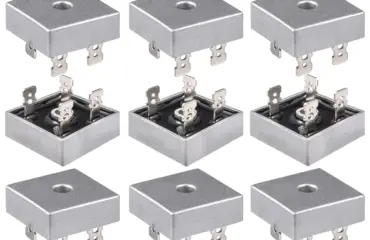
That is where the KBPC5010 becomes attractive. This bridge rectifier is widely used in high-current AC-to-DC conversion because it combines a robust current rating, a 1000 V reverse-voltage rating, and a metal package that can be mounted directly to a heatsink. In practical terms, it gives engineers a stronger foundation for designing a variable supply that is expected to survive repeated load changes, startup surges, and extended operating time.
This guide explains how to design a high-current variable DC power supply around a KBPC5010 bridge rectifier, what decisions matter most in each design stage, and why the same principles also matter in EV power electronics and charging infrastructure.
Why The KBPC5010 Fits High-Current Bench Supply Designs
A bridge rectifier only solves one part of the problem, but it solves a critical one. The rectifier determines how reliably the AC input is converted into usable pulsating DC before the filter and regulator stages take over. For engineers sourcing durable bridge rectifiers for prototype benches, test fixtures, or small production equipment, the KBPC5010 offers meaningful headroom where lighter packages often become the weak point.
| Parameter | Why It Matters In A Variable DC Supply |
|---|---|
| 50 A average forward current | Gives margin for higher-load applications, inrush events, and repeated testing cycles |
| 1000 V peak reverse voltage | Helps tolerate line-side transients and supports safer design margin |
| Metal case package | Enables direct heatsink mounting for better thermal control |
| Integrated bridge structure | Simplifies assembly compared with discrete diode arrangements |
The important point is not that every supply should run anywhere near 50 A continuously. The real value is that a properly derated KBPC5010 is better suited to high-stress use than a smaller rectifier that is already close to its limits.
The Four Stages Every Variable DC Supply Must Get Right
A high-current adjustable supply is easier to design when it is treated as four linked stages instead of one big circuit.
| Stage | Main Job | What Designers Need To Verify |
|---|---|---|
| Transformer | Steps mains AC down to the required secondary voltage | Secondary voltage, isolation, VA rating, inrush behavior |
| Rectification | Converts AC into pulsating DC | Current rating, reverse-voltage rating, thermal path |
| Filtering | Reduces ripple and stabilizes the DC bus | Capacitance, ripple current rating, discharge path |
| Regulation | Produces adjustable and controlled output voltage | Dropout margin, efficiency, current limit strategy |
Each stage affects the next one. If the transformer is undersized, the rectifier and regulator will run hotter. If the capacitor bank is too small, ripple becomes harder to control. If the regulation stage is chosen without considering heat, the supply may look acceptable on paper but fail in practical operation.
Start With The Transformer, Not The Regulator
Many first-time builders focus on the adjustable regulator first, but the transformer actually defines the electrical envelope of the whole supply. The secondary AC voltage determines the raw DC bus after rectification and smoothing, and that raw DC bus must be high enough to support the intended output voltage under load.
For a full-wave bridge, the unloaded DC voltage after the filter stage is roughly the secondary RMS voltage multiplied by 1.414, minus the voltage drop across two conducting diodes. In a practical high-current build, this means a 20 Vac secondary may deliver roughly 26 V to 27 VDC after rectification and smoothing before real-world load losses are applied.
Transformer sizing should also reflect output power, not just voltage. A supply intended to deliver 24 V at 10 A is already a 240 W output design, and the transformer must be rated with enough margin to handle conversion losses and heating. In many cases, designers add 20% to 30% headroom instead of sizing the transformer right at the theoretical minimum.
A few transformer rules are worth following early:
- Choose a secondary voltage that leaves enough regulation headroom without creating unnecessary heat.
- Size the VA rating for sustained load, not idealized math.
- Use proper primary and secondary fusing.
- Treat isolation and grounding as safety design requirements, not optional cleanup tasks.
Thermal Design Will Decide Whether The Supply Survives
The KBPC5010 can handle substantial current, but that does not mean it can be operated casually. In a bridge rectifier, two diodes conduct during each part of the AC cycle. That means the total voltage drop across the rectifier is the sum of two diode drops, and the resulting power dissipation becomes significant as current rises.
At 20 A load current, even a combined bridge drop of about 2 V means roughly 40 W of heat in the rectifier package. At 30 A, the dissipation can quickly move beyond 60 W depending on junction temperature and conduction conditions. That is enough to overheat the device if it is mounted with inadequate thermal contact or little airflow.
This is why the mechanical side of the design matters as much as the schematic. The rectifier should be mounted securely to an appropriately sized aluminum heatsink, thermal compound should be applied correctly, and the airflow path should be considered from the start rather than added as an emergency fix later. Engineers who want a refresher on the conversion path itself can review PandaExo’s explanation of how a bridge rectifier circuit works.
Good thermal practice for a KBPC5010-based supply usually includes:
- A metal heatsink with realistic surface area for the expected load profile
- Clean mounting surfaces and quality thermal interface material
- Adequate spacing from heat-sensitive capacitors and regulators
- Forced-air cooling for heavier duty cycles or enclosed chassis layouts
Size The Smoothing Capacitor For The Ripple You Can Tolerate
After rectification, the output is not clean DC yet. It is pulsating DC, which means the voltage rises and falls with each cycle unless the supply includes enough capacitance to smooth it. The capacitor bank is what turns the rectified waveform into a more stable DC bus that the regulation stage can work with.
A practical full-wave sizing rule is:
Capacitance approximately equals load current divided by (2 x line frequency x allowable ripple voltage).
For 50 Hz mains, the ripple frequency after full-wave rectification becomes 100 Hz. That makes it easier to estimate how much capacitance is needed for common design targets.
| Load Current | Target Ripple Voltage | Approximate Capacitance At 50 Hz Mains |
|---|---|---|
| 5 A | 2 V | 25,000 uF |
| 10 A | 2 V | 50,000 uF |
| 20 A | 2 V | 100,000 uF |
These values are only starting points. Real designs also need to consider capacitor ripple current rating, ESR, inrush stress, temperature performance, and the fact that capacitance tolerance can be wide. In higher-current builds, multiple capacitors in parallel are often preferred over a single very large part because they can distribute ripple current and improve layout flexibility. PandaExo’s article on sizing the smoothing capacitor for a rectifier circuit is useful if you want to push this part of the design more rigorously.
Decide Early Between Linear And Switching Regulation
Once the DC bus is smoothed, the output still needs to be adjustable. That is the job of the regulation stage, and this is where many high-current designs split into two very different paths.
| Regulation Approach | Best Fit | Strengths | Trade-Offs |
|---|---|---|---|
| Linear regulation with pass devices | Lower-noise bench supplies, moderate current levels | Cleaner output, simpler analog behavior | Large heat dissipation, bulky heatsinking |
| Switching buck regulation | Higher-current adjustable outputs, efficiency-focused designs | Better efficiency, reduced heat, smaller thermal burden | More control complexity, EMI management required |
A low-current regulator such as an LM317 can be useful in small adjustable supplies, but it is not enough on its own for a serious KBPC5010-based high-current design. Once current rises, designers usually move toward power pass transistors in a linear architecture or use a dedicated switching stage to avoid turning the regulator into a heater.
The right choice depends on the project goal. If low noise matters more than efficiency, a linear design may still be justified. If output current and thermal efficiency are the priority, a switching stage is often the stronger engineering decision.
Protection And Measurement Features Belong In The First Draft
A supply that can source significant current should never be built as if protection can be added later. High-current DC rails can destroy semiconductors, wiring, and capacitor banks very quickly if the design does not include controlled fault behavior.
At minimum, a practical build should evaluate the following protection and usability features:
- Primary fuse or breaker sized for the transformer input
- Secondary-side protection sized for the output stage
- Inrush limiting or soft-start to reduce capacitor charging stress
- Output current limiting or foldback strategy
- Thermal monitoring for the rectifier and heatsink
- Bleeder resistors to discharge the capacitor bank after shutdown
- Panel metering for both voltage and current
- Proper conductor sizing and secure mechanical terminals
These additions do not make the design less elegant. They make it realistic.
Why These Same Design Choices Matter In EV Power Electronics
The reason this topic matters beyond the bench is simple: the same core power-conversion logic shows up again in larger systems. The discipline required to choose a transformer, manage rectifier heat, smooth a DC bus, and regulate output safely is directly connected to the engineering of charger power stages, test equipment, and broader EV infrastructure.
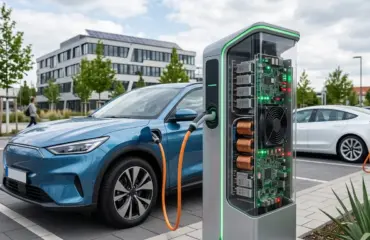
That is one reason PandaExo continues to invest in both semiconductor capability and finished charging systems. The same design priorities behind a stable KBPC5010-based supply also appear in PandaExo’s work on bridge rectifiers in EV charging infrastructure: reliable AC-to-DC conversion, controlled thermal behavior, and power stages designed for repeatable operation under demanding loads.
For engineering teams, the lesson is straightforward. A rectifier is never just a small supporting part. In many systems, it is one of the components that determines whether the whole power stage feels industrial and reliable or fragile and temporary.
Final Takeaway
Designing a high-current variable DC power supply around a KBPC5010 bridge rectifier is not complicated because the theory is mysterious. It becomes challenging because every stage has real consequences for heat, ripple, efficiency, safety, and long-term durability.
If the transformer is chosen correctly, the rectifier is properly heatsinked, the capacitor bank is sized for acceptable ripple, and the regulation stage matches the target load, the KBPC5010 can serve as a highly practical foundation for a robust adjustable supply. That makes it a strong option not only for laboratory power equipment, but also for the broader class of power-conversion systems that support EV testing, charger validation, and industrial electronics development.
For PandaExo readers, that is the real strategic takeaway: good power infrastructure starts with disciplined component choices. The better those choices are at the rectification stage, the easier it becomes to build reliable systems upstream and downstream.