
 Deutsch
  Español
  Français
  Italiano
  Português
  Svenska
  Suomi
Suomi  Dansk
Dansk  Norsk bokmål
  Nederlands
  العربية
  עברית
עברית  Polski
  Türkçe
  Русский
  Uzbek
Uzbek  Azərbaycan
  Tiếng Việt
  ไทย
ไทย  한국어
한국어  日本語
日本語  简体中文
简体中文 
As EVs become more useful for road trips, mobile work, camping, and service fleets, drivers are asking a more practical question: can the car safely power small appliances for extended periods? A mini-fridge is one of the most common examples because it adds convenience without seeming like a major electrical load.
The answer is yes, but only if the load, voltage, and startup behavior are understood correctly. In a Tesla, the issue is not just whether a fridge can run. The real issue is whether it can run without overloading the low-voltage system, tripping protection, or creating unnecessary conversion losses.
This guide explains how Tesla low-voltage architectures work, how to choose the right fridge, and what to verify before plugging anything in.
Why the Low-Voltage System Matters More Than Most Drivers Think
Every Tesla uses two separate electrical domains. The high-voltage battery powers propulsion. The low-voltage system runs accessories, lighting, control electronics, and convenience loads. When you power a fridge from the cabin outlet, you are using the low-voltage side, not the traction battery directly.
That distinction matters because low-voltage accessory circuits have stricter limits than the main battery system. A small appliance can still cause problems if its startup surge, inverter losses, or voltage requirements exceed what the outlet or converter path is designed to support.
Understanding Tesla’s Auxiliary Power Architecture
Tesla’s accessory power strategy is evolving. Older and mainstream vehicle platforms rely on low-voltage systems around 12V to 16V, while newer platforms such as Cybertruck move toward a 48V architecture.
The commercial logic behind that change is straightforward. Higher low-voltage architecture allows the same power to be delivered with less current, which reduces heat in wiring and improves electrical efficiency.
The table below shows the practical difference.
| System Type | Typical Vehicle Context | What It Means for Accessory Loads |
|---|---|---|
| 12V to 16V low-voltage system | Common in Model S, 3, X, and Y generations | Works with many automotive 12V devices, but outlet current remains limited |
| 48V low-voltage system | Newer architecture, especially Cybertruck direction | Better wiring efficiency, but legacy 12V accessories need voltage conversion |
For operators and technically minded owners, the key lesson is simple: the fridge must match the vehicle’s usable accessory output path, not just the brand of the car.
12V and 48V Systems Are Not Interchangeable by Default
The most important difference between Tesla low-voltage systems is not the label. It is how much current must flow to deliver the same power.
At lower voltage, more current is required for the same appliance load. That means more heat in wiring, more stress on connectors, and tighter margin for startup surge events. At 48V, the same power can be delivered with much lower current, but a standard 12V mini-fridge cannot simply be connected directly without the correct step-down solution.
| Technical Factor | 12V to 16V System | 48V System |
|---|---|---|
| Current needed for the same power | Higher | Lower |
| Wiring efficiency | Lower than 48V architecture | Higher because current is reduced |
| Compatibility with standard 12V car fridges | Usually direct, if outlet rating is respected | Requires a proper 48V-to-12V converter unless the fridge supports native 48V |
| Risk of user error | Often surge overload or outlet overcurrent | Often wrong-voltage connection if conversion is ignored |
This broader shift in onboard power design reflects the same engineering priorities seen in modern EV power management and DC-DC conversion: lower losses, less heat, and better system efficiency.
Choose the Fridge Type Before You Think About Installation
Not all mini-fridges are equally suitable for vehicle use. The safest and most efficient option is usually a DC compressor fridge designed for automotive or mobile environments. Standard dorm-style AC fridges can work only if paired with an inverter, but that adds complexity and conversion loss.
| Fridge Type | Power Path | Typical Efficiency Profile | Practical Recommendation |
|---|---|---|---|
| DC compressor fridge | Vehicle low-voltage system directly powers the fridge | Higher efficiency because there is no extra DC-to-AC conversion step | Best option for Tesla use in most cases |
| Household AC mini-fridge | Vehicle low-voltage power feeds an inverter, then the fridge | Lower efficiency because the inverter introduces losses | Use only if power draw and startup surge are well understood |
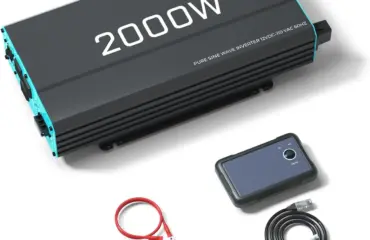
This is the same power-conversion principle that matters in many EV and infrastructure applications: every conversion stage adds loss, heat, and failure points. When you add an inverter to run an AC fridge, that system has to be sized correctly and protected correctly. If you are comparing inverter quality for mobile use, PandaExo’s guide to pure sine wave versus modified sine wave inverters for EV camping is the more relevant reference.
Startup Surge Is Usually the Hidden Problem
A mini-fridge may look safe on paper because its running wattage appears low. The problem is that compressors draw more power at startup than they do in steady operation. That brief surge can be enough to trip protection even when normal running load is well within the outlet limit.
Before installation, confirm all of the following:
- The fridge’s running wattage.
- The fridge’s startup or surge wattage.
- The outlet or circuit current limit in the vehicle.
- Any voltage cut-off behavior built into the fridge.
- Whether an inverter or step-down converter adds extra loss or surge demand.
If any one of those values is uncertain, the setup should not be treated as safe yet.
A Practical Safety Checklist Before Plugging In
The fastest way to avoid mistakes is to evaluate the setup before connecting the appliance.
| Checkpoint | Why It Matters | Safe Direction |
|---|---|---|
| Confirm system voltage | Wrong voltage can damage the fridge or converter | Match the fridge to the vehicle output or use the proper converter |
| Verify continuous power draw | Running load must stay within the outlet’s sustained capability | Keep steady draw comfortably below the socket limit |
| Verify startup surge | Compressor startup can exceed normal load by a wide margin | Make sure peak surge remains below the circuit protection threshold |
| Avoid cheap conversion hardware | Poor-quality inverters and converters waste power and create heat | Use reputable automotive-grade hardware |
| Plan for parked-vehicle behavior | Tesla may reduce or cut accessory power when the vehicle sleeps | Use the correct operating mode if power must stay active |
How To Keep the Fridge Running While Parked
One practical issue many owners discover too late is that the car may shut down the accessory supply when it enters a sleep state. That means a fridge that works during driving may stop working when the vehicle is parked unless the correct operating mode is enabled.
Tesla operating behavior can vary by model and software generation, but the common pattern is that features such as Camp Mode or Sentry Mode may be needed to keep the low-voltage outlet energized for extended periods.
That is not just a convenience setting. It is part of the electrical plan. If the fridge must keep running while parked, the power-retention strategy should be verified before any real trip or field deployment.
When a 48V Vehicle Needs a Converter
If the vehicle uses a 48V low-voltage architecture and the fridge is a standard 12V unit, the connection needs a proper 48V-to-12V converter. This is not an optional accessory. It is the protection layer that makes the system electrically compatible.
The converter should be selected with enough margin for:
- Continuous running power
- Compressor startup surge
- Thermal performance in an enclosed vehicle environment
- Voltage stability under varying state-of-charge conditions
Undersized converters may appear to work briefly but still produce instability, shutdowns, or overheating under repeated compressor cycling.
Comparing 12V and 48V Tesla Setups for Mini-Fridge Use
| Category | 12V to 16V Tesla Setup | 48V Tesla Setup |
|---|---|---|
| Best appliance match | Automotive 12V DC fridge | Native 48V appliance or 12V fridge with step-down converter |
| Installation complexity | Lower | Higher because voltage conversion may be required |
| Efficiency path | Usually simpler for native 12V loads | Can be very efficient, but only with the correct converter design |
| Main risk | Overloading the outlet during startup surge | Using a 12V appliance without the proper voltage conversion |
| Best use case | Simple mobile cooling with low setup complexity | Advanced setups where higher-capacity low-voltage architecture is available |
What This Tells Us About EV Power Management More Broadly
Powering a fridge in a Tesla is a small-scale example of a much bigger engineering truth: efficient power conversion determines whether the system runs cool, stable, and reliably over time. The same principle applies at accessory level and at charging-network level.
In the cabin, it affects whether a small appliance can run without nuisance trips. Across the charging ecosystem, it affects whether AC charging and DC fast charging systems can operate with the efficiency, thermal stability, and uptime that commercial sites require.
That is why component quality still matters. Even in seemingly simple accessory applications, losses and heat always trace back to the quality of the conversion path. PandaExo’s article on why high-quality rectifier diodes matter for inverter reliability expands on that same principle from the power-electronics side.
Final Takeaway
Yes, a Tesla can safely power a mini-fridge, but the setup has to respect the low-voltage architecture, the appliance type, and the compressor’s startup behavior. For most users, a properly sized DC compressor fridge is the safest and most efficient option. For 48V platforms, the right converter becomes a critical part of the system.
The broader lesson is that safe accessory power is really a power-conversion problem. If you understand the voltage, current, surge, and conversion path, the setup becomes predictable. If you ignore them, even a small appliance can become an avoidable failure point.